How to Control Particle Size in a Grinding Mill?
Grinding is a core score in the powder processing workflow. Through it, raw materials, which should be crushed, are transformed into fine powders with a controllable particle size. We often chase high precision or a finer final particle size to ensure the quality of products. However, a finer particle size is not always better.
The material, as calcium carbonate, quartz, and talc, has different applications that impose specific requirements regarding powder fineness and particle size distribution. Only maintaining the particle size within the optimal range can we meet quality standards while avoiding unnecessary grinding costs.
Which factors influence final particle size?
How can we prevent over-grinding or inconsistent particle size in a grinding mill?
Why Is Powder Particle Size Control So Important?
1. Different requirements by application
How many tons of powder can equipment produce per hour? How fine can it grind?
Let’s take calcium carbonate as an example, which is widely used across various industries. When used in construction materials, calcium carbonate powder typically doesn’t need a high degree of fineness. However, if the product is intended for filler in plastics or an ingredient in coatings, the particle size and dispersion characteristics become critical.
2. Finer is not always better
Many clients often focus specifically on the maximum level of fineness the machine can achieve when they need grinding mills.
But finer is not always better. Once a powder meets the required specifications, further grinding only consumes additional energy and then makes waste. Moreover, an excess of ultrafine particles can increase the tendency for agglomeration, making subsequent dispersion and processing significantly more difficult.
What factors affect the particle size of the finished product from a grinding mill?
1. Hardness and Physical Properties of Raw Materials
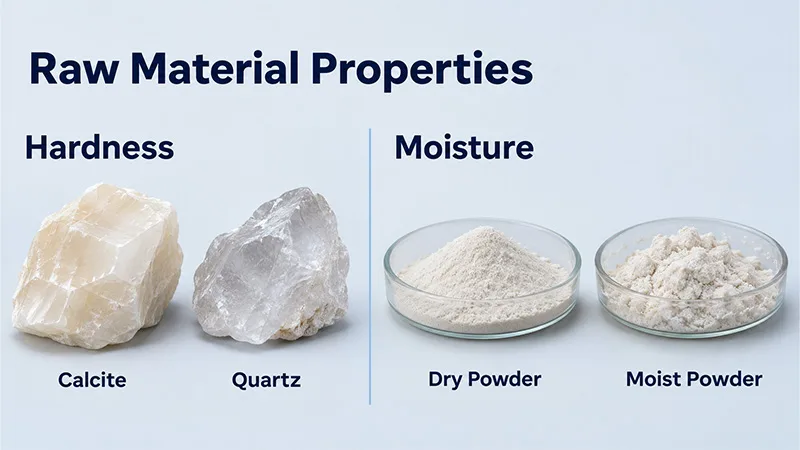
Raw materials often used in industrial powder processing vary significantly in terms of hardness, brittleness, toughness, and moisture content. These physical and chemical properties decide the necessary adjustments to equipment parameters.
Calcite and quartz are quite different in hardness, so they can’t use the same operating parameters to process. If the raw material has a high moisture content, fine particles may adhere to one another or form clumps, which hinders the smooth flow of material through the grinding mill and the classification system.
2. Efficiency of the Air Classification System
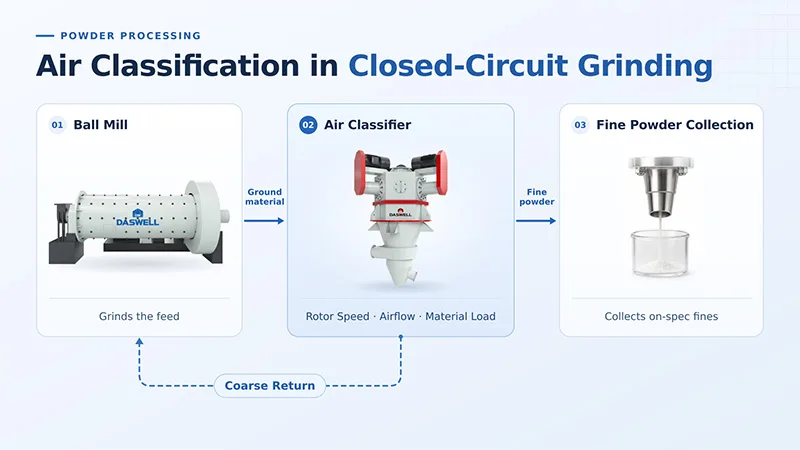
In a complete powder production process, the grinding mill is responsible for grinding the material, while the air classifier controls and separates the final product based on particle size.
Milled material consists of particles in varying sizes. The classification system isolates the fine particles that meet the required specifications, while coarser particles are returned to the mill for further grinding. If the rotational speed of the classification wheel, airflow conditions, or material load change, the effectiveness of the classification process must be influenced.
Over-grinding and Under-grinding:
Why Can Excessively Fine or Coarse Powders Cause Problems?
1. What is over grinding?
Overgrinding occurs when material is subjected to more grinding than is required for the final product, resulting in unnecessary size reduction.
When grinding fineness powder, some particles may reach the desired size, but they fail to exit the grinding system promptly. They are still ground, creating ultra-fine particles. This changes the particle size of the finished product and also increases the energy consumption per unit.
It is important to distinguish overgrinding from the intentional production of ultra-fine powders. If a client requires a powder with a particle size of a few microns or less, further grinding is simply part of the standard production process. Over-grinding only occurs when the additional grinding exceeds the product’s requirements.
2. What is under grinding?
Under grinding refers to a situation where material hasn’t been sufficiently ground, leaving some particles larger than the target size.
When the feed rate is excessive, grinding capacity is insufficient, or the particle size of the raw material increases significantly, some of the material may not be sufficiently pulverized. If the classification system fails to prevent these coarse particles from entering the final product, they may fail to meet the required fineness specifications.
But in a properly configured closed-circuit grinding system, coarse particles are returned directly to the mill for further processing. So under grinding may manifest as an increase in the circulating load or a decrease in effective production output.
How to Effectively Control the Particle Size of Finished Products from a Grinding Mill? 4 Practical Methods
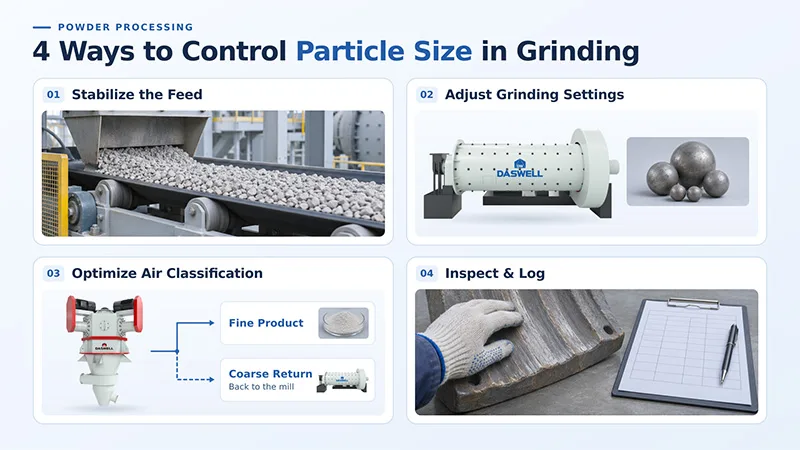
1. Maintain Stable Feed Particle Size and Feeding Rate
If the particle size of the raw material changes a lot, or if the feeder fails to provide a consistent supply, the material load inside the grinding mill will constantly shift.
When the feed rate increases suddenly, the grinding mill may be unable to process the additional material under existing operating conditions, which compromises grinding efficiency.
2. Adjust Grinding Parameters Based on Target Fineness
For ball mills, the size and grading of the grinding media, the rotational speed of the mill shell, and the system throughput are key factors.
For Raymond mills and ring-roller mills, consider the equipment’s specific design while checking the condition of the grinding components, the operating parameters of the main unit, and the material load is right.
3. Optimize the Air Classification System
In production lines equipped with dynamic air classifiers, the rotational speed of the classification wheel is a key parameter influencing the cut-point particle size.
Increasing the speed of it generally helps produce finer material, though it may also increase the volume of coarse particles recirculated back into the mill, thereby affecting the system’s overall processing capacity.
4. Regularly Inspect Equipment and Production Records
If the particle size of the finished product changes after the grinding mill has been in operation for some time, it is essential to check for wear on critical components.
For production lines that operate continuously over long periods, it is recommended to maintain records of data such as equipment current, vibration levels, production output, system pressure differential, and product fineness.
How is the particle size of the final product controlled in different types of grinding mills?
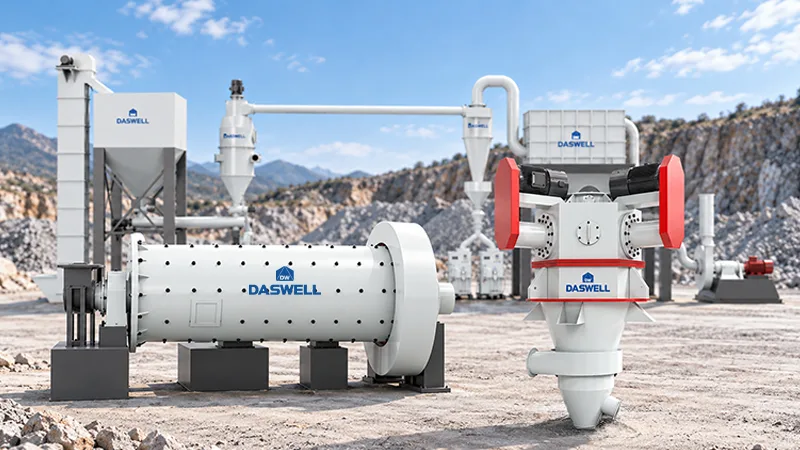
1. Ball Mill: Suitable for use in a closed-circuit grinding system with an air classifier
In the processing of minerals such as calcium carbonate, quartz, feldspar, and talc, ball mills are frequently paired with air classifiers.
The ball mill grinds the material, while the air classifier separates the fine particles that meet the required specifications. Coarse particles that have not yet reached the target size are returned to the mill for further processing. This helps control the final product’s particle size and prevents the over-grinding of particles that are already sufficiently fine.
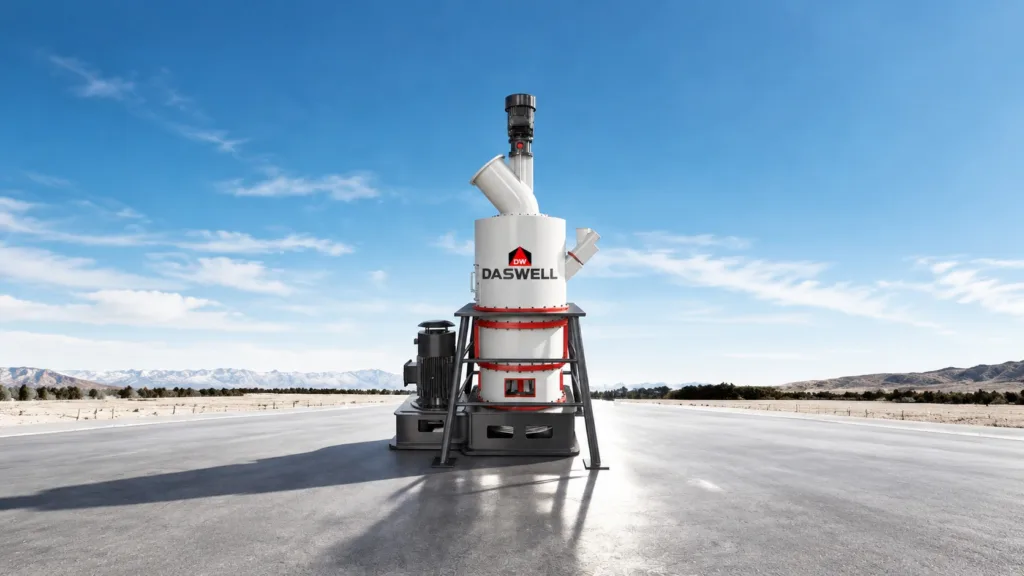
2. Ring Roller Mill: Suitable for the production of fine and ultra-fine powders
If you want to produce finer mineral powders, a ring roller mill is worth considering.
Ring roller mills primarily utilize the compression and shearing forces between grinding rollers and a grinding ring to reduce the size of materials, which are commonly used for minerals such as calcium carbonate, talc, and kaolin.
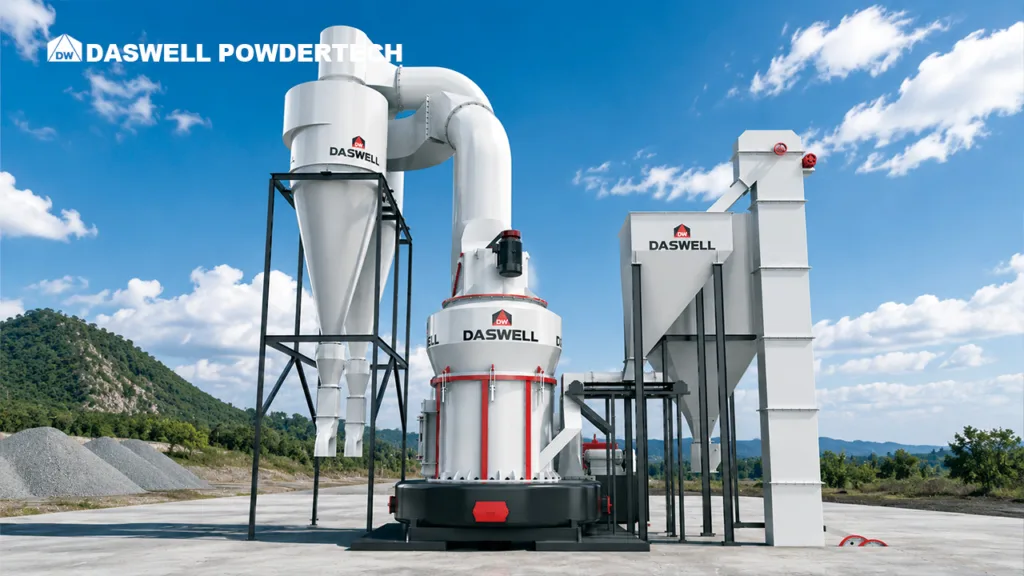
3. Raymond Mill: Suitable for the processing of conventional mineral powders
The Raymond mill is a common piece of equipment in the industrial production of mineral powders.
It grinds material through the grinding action between rollers and a ring and also employs airflow and a classification device to control the fineness of the final product. It is a reliable choice for processing standard mineral powders, such as those derived from limestone or calcite.
4. Air Classifier: Essential for stable particle size control in grinding systems
In a closed-circuit grinding system, the grinding mill is responsible for reducing particle size, while the classifier determines which particles are discharged as the final, qualified product.
If the classification system operates inconsistently, it can lead to fluctuations in particle size or result in the unnecessary re-grinding of material—even if the grinding mill itself possesses sufficient capacity.
How to Choose the Suitable Grinding Mill Based on Target Particle Size?
1. What type of powder do you need to produce?
Even if the material is the same, such as calcium carbonate, it must be significantly different from those for powder used in high-quality coatings.
If you can provide specific metrics, such as D50, D97, or other particle size indicators, more accurate judgments will be made regarding which options are suitable for your project.
2. What is your desired actual production capacity?
The production capacity of a grinding mill is closely related to the target fineness.
In an equal situation, as the target particle size becomes finer, the effective processing capacity of the equipment typically decreases.
3. Does your raw material have any unique properties?
Particle size is first, but hardness, abrasiveness, moisture content, and purity requirements and any specific processing needs also should be considered.
Highly abrasive minerals, like quartz, may demand greater wear resistance from the equipment, while the production of certain high-purity powders requires careful attention to potential contamination during the grinding process.
4. Will products with different levels of fineness be produced in the future?
Some clients may produce only one type of powder. As market demand evolves, they might need to introduce additional fineness grades.
Although actual production capacity and energy consumption will vary depending on the fineness level, a production line with flexible parameter-adjustment capabilities can readily adapt to diverse order requirements.
FAQ
1. Why does the fineness of the finished product from a grinding mill change suddenly?
We suggest checking whether there have been any changes to the raw material properties, feed particle size, or feed rate. If the feed conditions are normal, proceed to inspect the grinding components, the classification system, and the equipment’s operating parameters.
2. Will increasing the rotational speed of a grinding mill result in a finer powder?
Not necessarily. Different types of equipment have different principles; if rotational speed changes, grinding results too. It is advisable to adjust parameters based on the specific equipment type and actual production data, rather than simply increasing the rotational speed.
3. How can “over-grinding” be avoided during the pulverization process?
Analyze the actual particle size to confirm if an excessive amount of ultra-fine particles is being produced firstly. Then, check the grinding parameters, material retention time, and the classification system. For closed-circuit grinding lines, ensuring that the appropriately sized fine particles are discharged promptly is an effective way to reduce repeat grinding.
4. Which is more important: D50 or D97?
This depends on the usage of products. D50 represents the median of the particle size distribution, while D97 is more commonly used to describe the particle size at the coarser end of the distribution.
5. Can a grinding mill produce powders of different fineness levels?
Yes, the specific adjustment range depends on the equipment model and the configuration of the classification system. Some grinding systems can produce powders of various specifications by adjusting classification parameters; but it is worth noting that this may also affect actual throughput and energy consumption.
For powder processing, controlling the particle size is not a task that only needs to be addressed in equipment startup. The ideal grinding operation consistently produces powder that meets specific requirements—all at a reasonable cost. If you are setting up a new powder production line, please contact us for assistance. Daswell Powder offers a wide range of powder processing solutions, including Ball Mills, Ring Roller Mills, Raymond Mills, and Air Classification Equipment.