
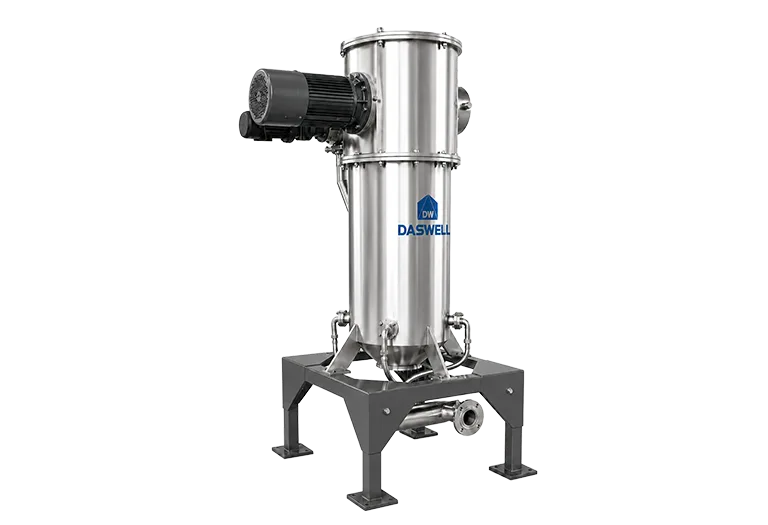
Air Jet Mill
DaswellPowder air jet mill combines dry ultrafine grinding and precision air classification in one system. It uses filtered, dried, and oil-free compressed air as the grinding gas. High-velocity air streams accelerate the particles and cause repeated particle-to-particle collisions, reducing the material to micron-sized powder.
The jet mill is suitable for processing non-metallic minerals, advanced materials, fine chemicals, food materials, battery materials, and more. DaswellPowder supplies standalone jet mills, auxiliary equipment, and complete jet milling production lines.
What Is an Air Jet Mill?
A jet mill, also known as an air jet mill, is an ultrafine grinding machine that uses compressed air or another process gas to generate high-velocity jets for dry micronization.
Unlike ball mills, ring roller mills, and impact mills, a jet mill does not use grinding balls, rollers, or hammers to apply direct mechanical force. Instead, size reduction occurs mainly through high-speed interparticle collisions, impact, and shear.
Because no grinding media are required, jet milling reduces the risk of contamination caused by grinding media wear. It is particularly suitable for applications with strict requirements for final fineness, powder purity, low-temperature processing, and controlled particle size distribution.
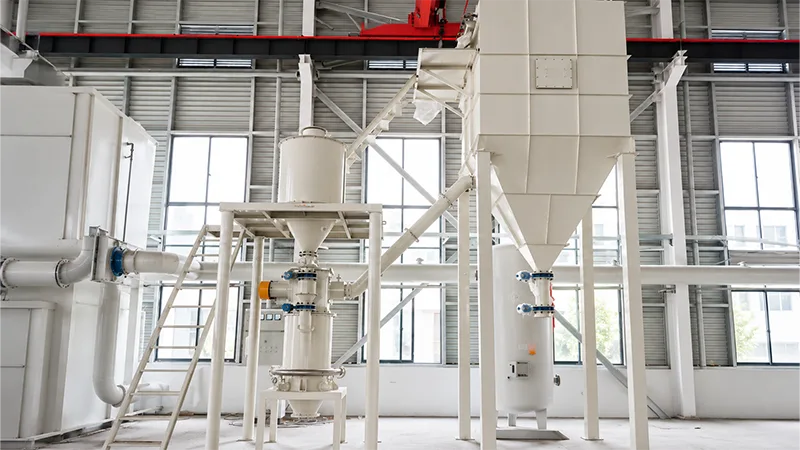
Air Jet Mill: Process Flow & Technical Specifications
A standard DJM jet mill production line includes an air compressor, air receiver tank, air filters, refrigerated air dryer, feeding system, jet mill, integrated classifier, cyclone collector, bag filter, induced draft fan, and electrical control system. Inert gas protection and a closed-loop system are available for flammable, easily oxidized, or other safety-sensitive materials.
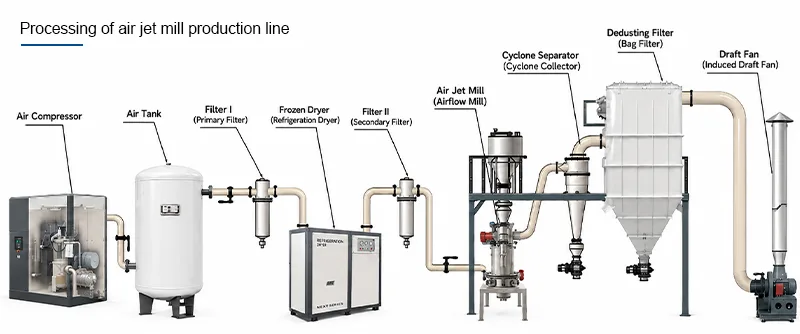
Compressed air from the air compressor first enters the air receiver tank to stabilize the system pressure. It then passes through a primary filter, refrigerated air dryer, and secondary filter to remove moisture, oil, and other contaminants.
The material is fed into the jet mill through a controlled feeding system. Clean, dry compressed air is accelerated through Laval nozzles to generate high-velocity jets and fluidize the material inside the grinding chamber. At the intersection of the jets, particles are reduced in size through repeated interparticle collisions, impact, and shear.
The ground particles move upward into the integrated classification zone. Fine particles that meet the required cut size pass through the dynamic classifier wheel, while coarse particles are returned to the grinding zone. Product fineness and particle size distribution can be controlled by adjusting the classifier wheel speed, grinding air pressure, and feed rate.
The qualified powder is conveyed to the cyclone collector for gas-solid separation. Remaining fine particles are captured by the bag filter, and the cleaned air is discharged by the induced draft fan. The complete jet milling line operates under negative pressure to minimize dust leakage.
| Model | Compressed Air Consumption (m³/min) | Operating Pressure (MPa) | Feed Size (mm) | Product Size (μm) | Capacity (kg/h) | Main Unit Power (kW) | Auxiliary Power (kW) |
|---|---|---|---|---|---|---|---|
| DJM-02 | 2 | 0.85 | <2 | 1–150 | 0.2–2 | 4.5 | 17 |
| DJM-03 | 3 | 0.85 | <3 | 1–150 | 5–15 | 8 | 24 |
| DJM-06 | 6 | 0.85 | <3 | 1–150 | 10–50 | 12 | 40 |
| DJM-10 | 10 | 0.85 | <3 | 1–150 | 30–150 | 15 | 79 |
| DJM-20 | 20 | 0.85 | <3 | 1–150 | 100–400 | 26 | 136 |
| DJM-40 | 40 | 0.85 | <3 | 1–150 | 300–1000 | 40 | 260 |
(The specifications above are provided for preliminary model selection. Actual capacity and product fineness depend on the material properties, feed size, target particle size, and operating conditions. Final specifications are subject to the confirmed technical proposal.)
Air Jet Mill Applications for Different Materials and Industries
The DJM series jet mill can process non-metallic minerals, advanced materials, fine chemicals, food ingredients, battery materials, and other industrial powders.
Since materials vary in hardness, brittleness, moisture content, abrasiveness, and temperature sensitivity, the jet mill configuration can be customized according to the target fineness, powder purity, and required production capacity.
Non-Metallic Minerals
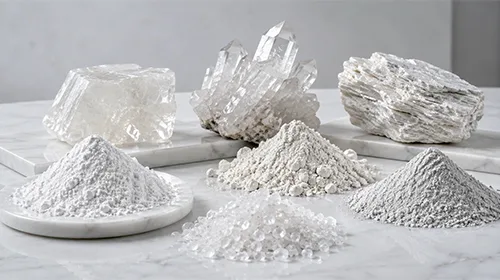
The jet mill can be used for the ultrafine grinding of silica, gypsum powder, mica, calcium carbonate, kaolin, barite, quartz, graphite, talc, and other non-metallic minerals.
For abrasive materials such as quartz and silica, suitable wear protection and contamination-control measures can be selected according to the required product purity.
Advanced Materials
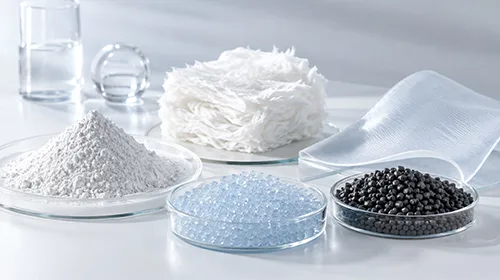
Typical materials include coarse-pore silica gel (Type C silica gel), ion-exchange resins, polyphenylene sulfide (PPS), and ceramic fibers.
For materials with strict purity requirements or special processing characteristics, the product-contact materials, classifier configuration, and process system can be customized accordingly.
Fine Chemicals

The DJM jet mill can process magnesium hydroxide, phosphorus-based flame retardants, synthetic wax, polystyrene, sodium pyrophosphate, anhydrous sodium bisulfate, and other fine chemical powders.
For hygroscopic, corrosive, or temperature-sensitive materials, the equipment material, sealing method, and process gas system should be selected according to the specific material properties.
Food Ingredients

The system can be used for the ultrafine grinding of certain food ingredients and food additives. Equipment materials, internal design, and cleaning methods should be configured according to the applicable hygiene and production requirements.
Battery Materials
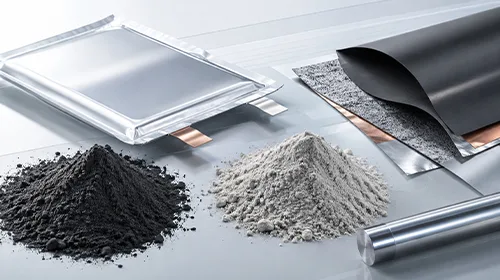
The jet mill can process titanium dioxide, copper oxide, and other battery-related functional powders. It helps control product fineness, particle size distribution, and contamination during grinding.
Key Features and Advantages of the DJM Series Air Jet Mill
Dry Ultrafine Grinding
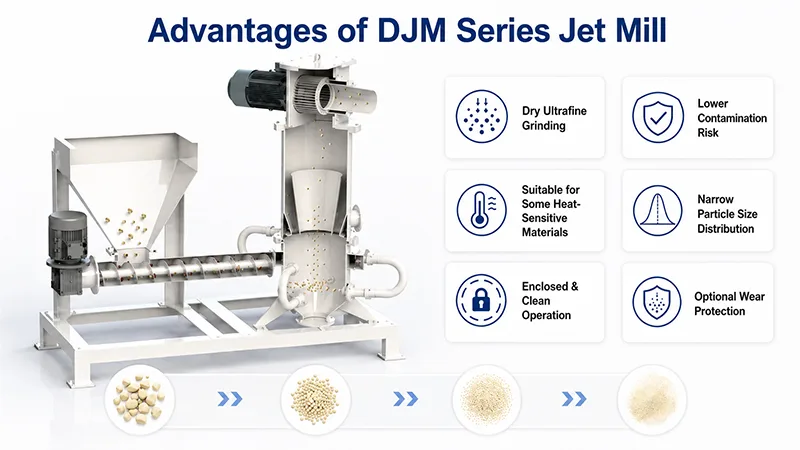
The DJM series jet mill uses high-velocity gas jets to produce fine, micron-sized powders from materials with a Mohs hardness below 9. Final fineness depends on material properties, feed size, grinding air pressure, classifier wheel speed, and system configuration.
Reduced Contamination Risk
Size reduction occurs mainly through interparticle collisions without grinding media, helping reduce contamination caused by media wear.
Suitable for Heat-Sensitive Materials
Gas expansion through the nozzles provides a cooling effect, while media-free grinding generates less frictional heat, helping limit temperature rise.
Narrow Particle Size Distribution and Reduced Overgrinding
The integrated classifier discharges qualified fines and returns coarse particles to the grinding zone, helping achieve a narrow particle size distribution while reducing oversized particles and overgrinding.
Enclosed and Clean Operation
The enclosed system reduces dust leakage and supports continuous production with relatively low operating noise.
Optional Wear Protection
Ceramic, zirconia, wear-resistant rubber, and other protective materials are available for abrasive products such as quartz and silica.
How to Choose the Right Air Jet Mill
Choose a jet mill based on material properties, feed size, moisture content, target fineness, capacity, product purity, and contamination-control needs—not capacity alone.
Heat-sensitive, oxidation-sensitive, flammable, or hygroscopic materials may require cooling, inert gas protection, explosion protection, or closed-loop operation. Single- or multi-wheel classifiers suit different fineness and capacity requirements, while classifiers installed in series can produce multiple size fractions.
Material testing is recommended for advanced or abrasive materials and strict fineness requirements. Results guide model selection, classifier configuration, wear protection, and operating parameters.
Contact Us
To request a price or equipment selection proposal for the DJM series jet mill, please contact us and provide your material name, feed size, target fineness, required capacity, and any purity or safety requirements.
DaswellPowder will recommend a suitable jet mill model and complete jet milling production line based on your material properties and production goals.