
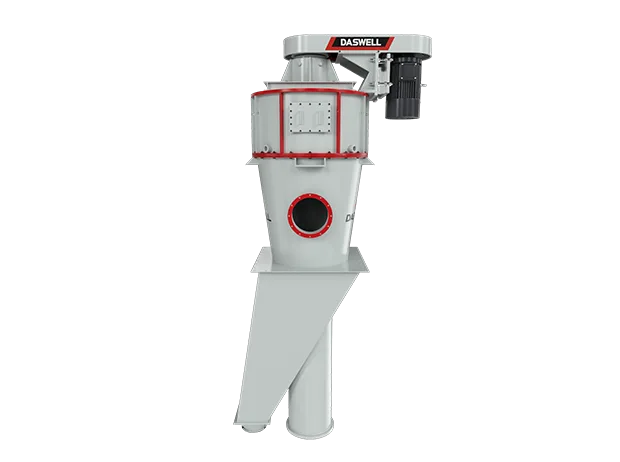
Single-Wheel Air Classifier
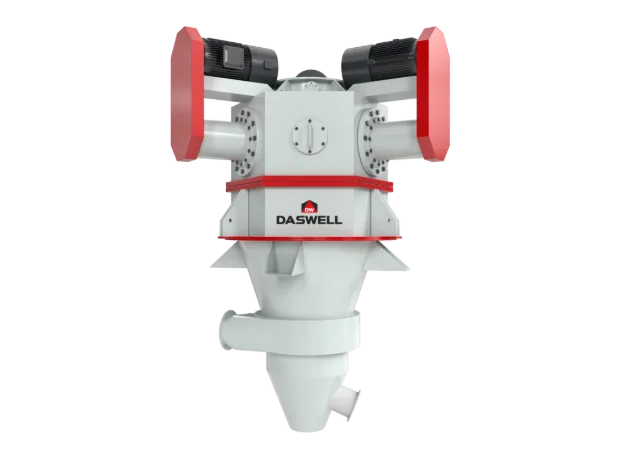
Daswell’s single-wheel air classifier is a high-capacity powder classification machine. Its single-wheel design with a vertical drive arrangement provides stable and efficient particle separation.
It is widely used for calcium carbonate, talc, kaolin, limestone, barite, and other mineral powders. This centrifugal air classifier performs best in the D97 8–25 μm range.
High-capacity Powder Classification With One Classifying Wheel
Daswell’s single-wheel air classifier uses controlled airflow and centrifugal force to separate fine powder from coarse particles. The classifier can operate independently or work with grinding mills in a closed circuit.
- Product fineness: D97 5–37 μm
- Best performance: D97 8–25 μm
- Feed rate: 2–45 t/h
Explore Daswell’s powder classifier machines for different materials, capacities, and fineness requirements.
Benefits of Single-Wheel Air Classifier
▸ High Feed Capacity with One Classifying Wheel
The product range covers feed rates from 2 to 45 t/h. The single-wheel design with a vertical drive arrangement provides high feed capacity without a multi-wheel arrangement. This makes the machine a practical choice for medium- and large-scale powder plants.
▸Best Suited for the 8–25 μm Range
The classifier can produce powder across a D97 range of 5-37 μm. Its strongest working range is between 8 and 25 μm. It is suitable for common filler grades used in plastics, coatings, paper, rubber, ceramics, and building materials.
▸Stable Particle Size Control
The rotating classifying wheel and controlled airflow create a stable classification field. This helps limit oversized particles and keeps the finished powder within the required size range. The cut point can be adjusted through wheel speed and airflow.
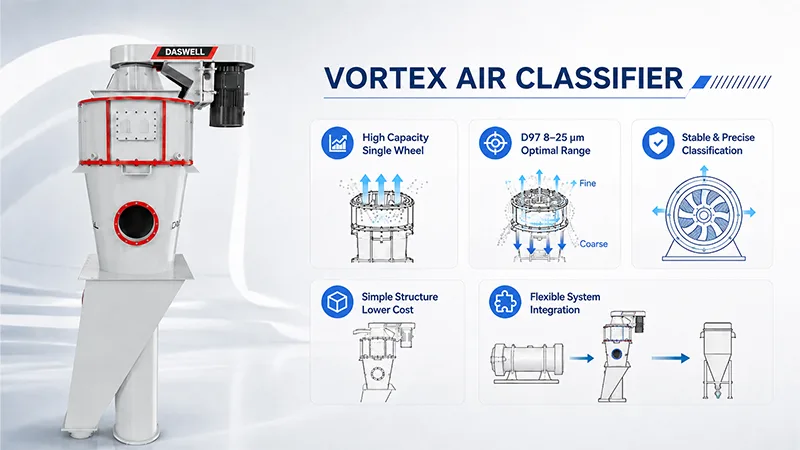
▸Lower System Complexity
One classifying wheel keeps the equipment arrangement straightforward. It also reduces the number of classifier drives required for high-capacity production. The simple system layout simplifies the drive arrangement and routine inspection.
▸Works with Different Grinding Mills
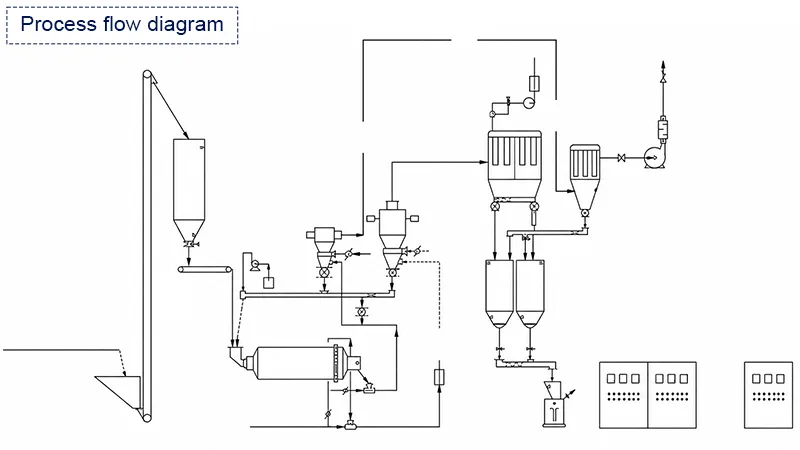
The classifier can be connected to a ball mill, impact mill, vibratory mill, or vertical mill. A ball mill machine and centrifugal air classifier can form a continuous closed-circuit system. Fine powder is collected as the finished product, while coarse powder automatically returns to the mill.
▸Suitable for Different Mineral Powders
The powder classifier is suitable for calcium carbonate, calcite, talc, kaolin, limestone, barite, quartz, silica, ceramic raw materials, and many other inorganic mineral powders. We select the right model and design the system based on material density, moisture content, feed size, target fineness, and required capacity.
Single-Wheel Air Classifier Technical Data
| Model | Feeding Capacity (t/h) | D97 Range (μm) | Output at D97 = 10 μm (t/h) | Power (kW) |
|---|---|---|---|---|
| ASS500 | 2-6 | 5-37 | 1.0-1.3 | 30 |
| ASS630 | 4-12 | 6-37 | 1.5-1.8 | 45 |
| ASS830 | 6-18 | 8-37 | 2.1-2.4 | 55 |
| ASS900 | 8-22 | 9-37 | 2.6-3.0 | 75 |
| ASS1000 | 10-28 | 9-37 | 3.2-3.5 | 75 |
| ASS1100 | 12-32 | 10-37 | 3.7-4.1 | 90 |
| ASS1200 | 15-38 | 12-37 | 4.3-4.5 | 110 |
| ASS1300 | 18-45 | 13-37 | – | 110 |
(Note: Feeding capacity refers to raw-material feed, not finished-product output. Actual performance depends on material properties, feed size, target fineness, and system configuration.)
How Does a Centrifugal Air Classifier Work?
› Material Feeding
Ground material enters the classifier at a steady rate. The process air carries the powder into the classification chamber and spreads it across the classification zone. Stable feeding is important. It keeps the material concentration even and helps maintain a consistent finished product.
› Centrifugal Classification
The classifier uses one classifying wheel with a vertical drive arrangement. As the wheel rotates, airflow drag and centrifugal force separate fine particles from larger particles. Two forces act on each particle:
- The airflow draws fine particles toward the classifying wheel.
- Centrifugal force pushes larger and heavier particles away from the wheel.
Fine particles pass through the wheel and leave the classifier with the airflow. Coarse particles are rejected.
› Fine Powder Collection
The qualified fine powder enters a cyclone collector or dust collector. It is then discharged into a finished-product silo or sent directly to the packing system.
› Coarse Powder Return
Rejected coarse particles leave through the coarse-powder outlet. In a closed-circuit system, they return to the grinding mill for further size reduction.
The operator can adjust the cut point by changing the wheel speed and system airflow. This allows the same classifier to produce different powder grades.
Air Classifier Applications for Mineral Powders
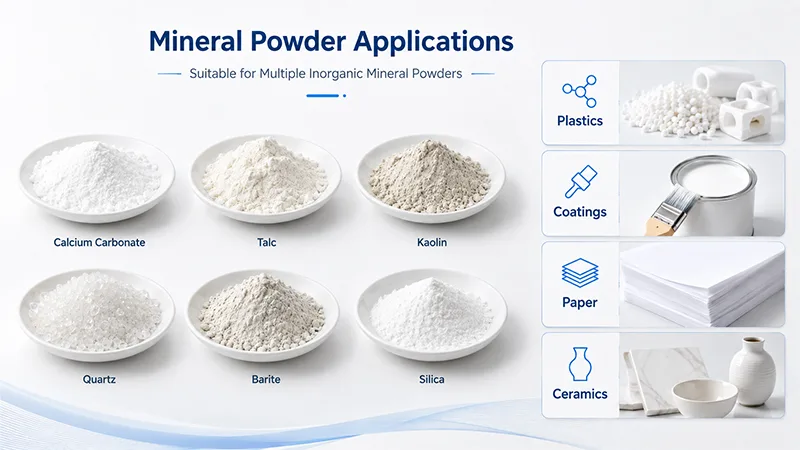
⁃Calcium Carbonate and Calcite
Produces fine powder for plastics, coatings, paper, rubber, and fillers. View our calcium carbonate grinding plant.
⁃Talc and Kaolin
Delivers consistent particle size for talc and kaolin. View our talc powder processing line.
⁃Quartz and Silica
Classifies quartz and silica with suitable wear protection. View our quartz powder processing solution.
⁃Limestone and Barite
Supports continuous limestone and barite powder production for construction, coatings, drilling, and fillers.
Single-Wheel Air Classifier vs. Turbo Classifier
Both machines are centrifugal air classifiers. The right configuration depends on the target product and production plan.
Choose Single-Wheel Air Classifier when:
- The target product is mainly D97 8–25 μm.
- High feed capacity is an important requirement.
- A single-wheel layout with a vertical drive arrangement is preferred.
- Extreme ultrafine classification is not the primary requirement.
Consider Turbo Classifier when:
- The target product is close to D97 3–10 μm.
- Precise ultrafine classification is the main priority.
- A modular single- or multi-wheel arrangement is required.
- Multiple wheels are needed to increase fine-product output.
Choose the Right Air Classifier for Your Powder Plant
To select a suitable classifier, please provide:
- Raw material
- Feed particle size
- Target D97
- Required capacity
- Material moisture
- Final powder application
Contact Daswell with your material and production target. Our engineers will recommend the classifier model and prepare a suitable process flow.