
Agrochemical Production Line
Daswell Powder Tech. offers customized processing lines for your agrochemical formulation production.
For both your wet liquid formulation and dry powder production, we provide different grinding lines based on formulation type, target particle size, and production capacity.
When planning agrochemical production, it is key for you to choose a suitable agrochemical production line. Daswell Powder offers you both dry and wet processing methods. They utilize different grinding mills for producing agrochemical formulations with consistent particle size. These solutions are applicable for producing herbicides, insecticides, and fungicides, including chlorothalonil-based products. According to your formulation and production requirements, we can customize agrochemical production lines.
What Is the Agrochemical Production Process?
In agrochemical manufacturing, there are wet and dry processing methods for you to choose. They are often used for different formulation production. The appropriate processing route mainly depends on the formulation type, target particle size, and required production capacity.
The main differences between these two processing technologies are grinding methods. The finished products manufactured by wet-type agrochemical processing lines are slurries. The dry grinding line produces dry powders. You can utilize it as a pre-processing line for granule production.
Wet Processing Line for Liquid Pesticide Formulations
Our wet processing line is suitable for producing SC and OD pesticide formulations. This process grinds and disperses the solid ingredients in a liquid medium. It ensures the solid active ingredient is distributed well throughout the liquid formulation. We mainly use bead mills as the core grinding mill.
Pesticide Wet Processing Line
A typical wet processing line for pesticide suspension concentrates is: Ingredient Preparation and Premixing → Intermediate Tank → Bead Milling → Formulation and Blending → Finished Product Tank
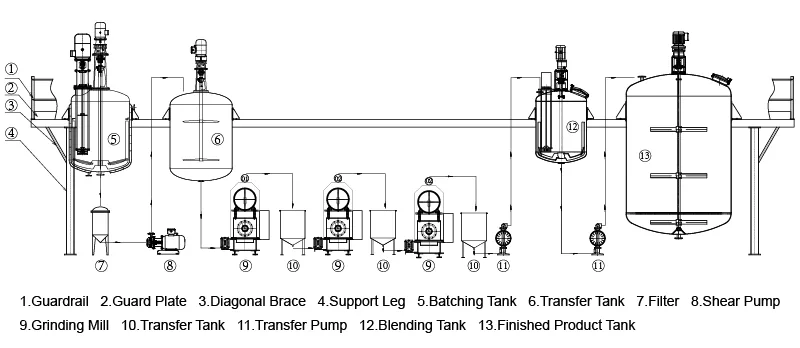
Based on your specific product requirements, we customize a processing line tailored to your production needs. From process flow design and bead mill rotor configuration to equipment materials and grinding media selection, every solution is engineered to deliver the required performance, quality, and production efficiency.
Dry Processing Line for WP and WDG
A dry processing line for pesticide powders mainly focuses on grinding and powder handling. For WDG production, it needs additional granulation and downstream processing equipment.
The dry grinding process turns solid pesticide ingredients into fine powder without grinding media. Most of our customers choose the air jet mill machine for grinding. It uses high-velocity compressed air to drive particle-to-particle collisions. The integrated classification system separates particles according to size. The adiabatic expansion of compressed gas at the nozzles produces a cooling effect. This helps prevent thermal degradation, melting, or agglomeration of heat-sensitive pesticide active ingredients.
Pesticide Dry Grinding Process with Air Jet Mill Machine
A typical dry grinding line for pesticide powders is: Raw Material Premixing → Air Jet Milling → Collection → Post-Blending → Quality Testing and Packaging
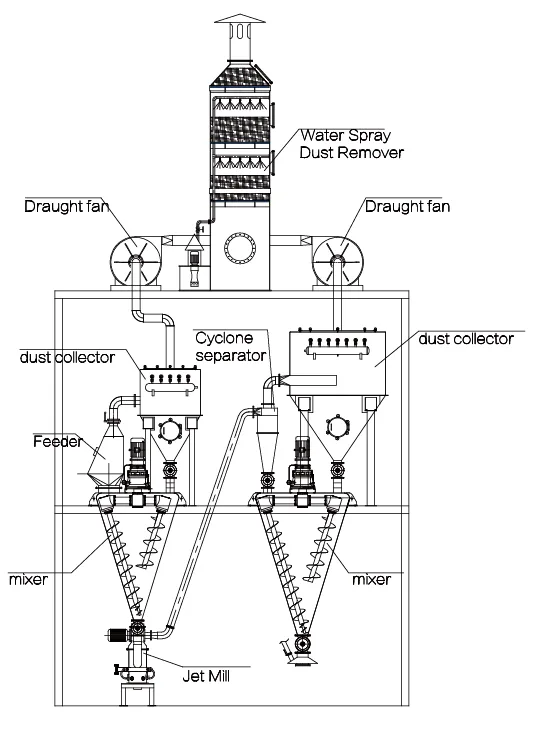
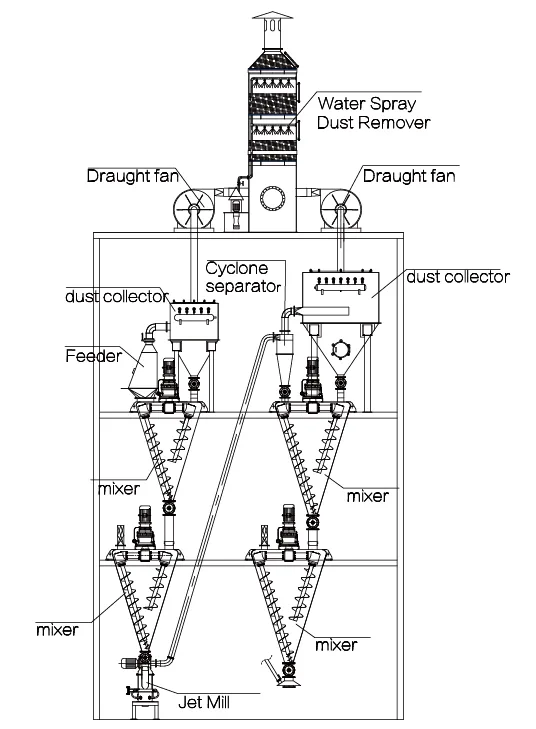
This dry air jet mill grinding line is mainly used for producing WP. For your pesticide granule manufacturing, there are also mixing, granulating, drying, sieving, and packing equipment for you to choose. The specific configuration depends on the formulation and production process. Contact us to discuss your requirements.
What Should Be Considered in Agrochemical Production Plant Design?
When you establish an agrochemical production plant, there are several factors you should consider first. You had better evaluate the formulation, production targets, and the operating environment. These factors determine the grinding technology, equipment configuration, and overall production line design.
Identify the Agrochemical Formulation Type
Determining the intended product is the first step.
Different formulation types require different grinding technologies.
Evaluate Raw Material Properties
The active ingredient and other solid materials influence the choice of grinding technology.
Different hardness, abrasiveness, moisture content, heat sensitivity, corrosiveness, and flowability affect the grinding technology selection and system design.
According to your material properties, our engineers can configure a grinding line that meets your product quality standards and operating conditions.
Define the Target Particle Size and Capacity
Target fineness and required output are two key factors in grinding line design.
Under the same capacity requirements, we have different solutions for different particle size requirements. Tell us the D50 or D90 and capacity requirements, and discuss a suitable pesticide grinding line.
If you are planning a new agrochemical formulation plant or upgrading an existing production line, Daswell Powder can work with you to evaluate the processing route and equipment configuration based on your production requirements.
Contact Daswell Powder with your formulation type, raw material information, target particle size, and required capacity to discuss a suitable wet or dry processing solution for your pesticide production line.