Calcium Carbonate Powder for Paper Industry — From Filler to Coating
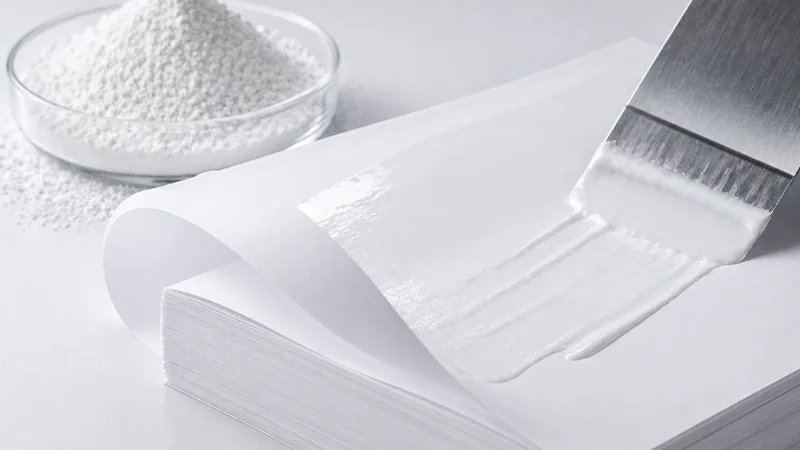
In modern paper manufacturing, calcium carbonate powder for paper industry (CaCO₃) is an important mineral raw material. It not only affects paper brightness, smoothness, and opacity, but is also directly related to production cost.
From ordinary copy paper to high-grade coated paper, from packaging board to inkjet printing paper, calcium carbonate powder is widely used in many paper products in the paper industry worldwide.
Why Calcium Carbonate Becomes an Important Raw Material in the Paper Industry
The main advantage of calcium carbonate powder for paper making is that it improves paper quality while reducing cost.
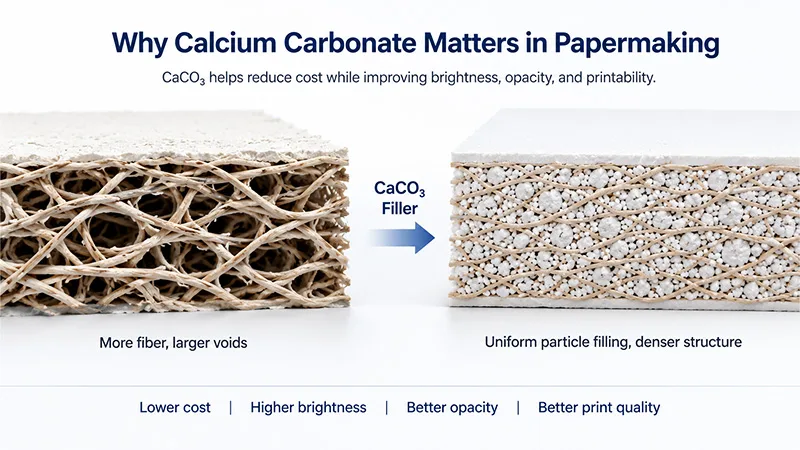
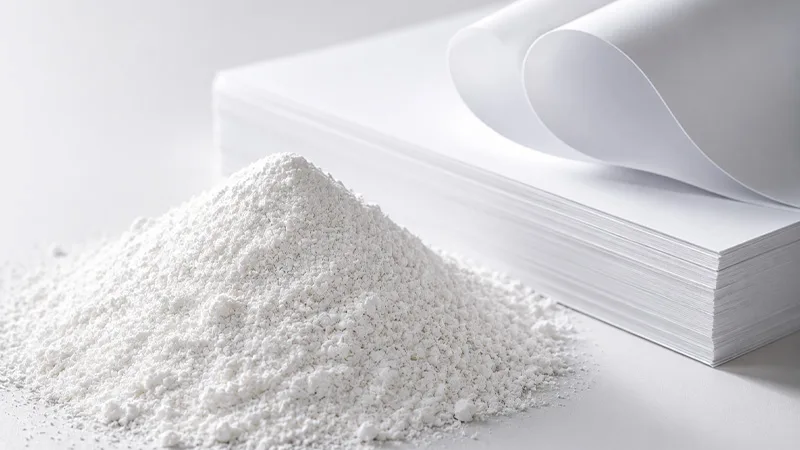
Wood pulp fiber is the basic raw material for papermaking, but its cost is relatively high. By adding calcium carbonate powder as a filler into pulp, part of the wood fiber can be replaced, reducing raw material cost while improving paper thickness, stiffness, and paper texture.
Calcium carbonate itself has high whiteness, which helps improve paper brightness and opacity, making printed images clearer and reducing show-through. For inkjet printing paper and other digital printing papers, paper coating calcium carbonate also helps control ink droplet spreading and absorption, improving printing quality.
👉 Calcium carbonate is widely used in paper mills and paper production lines across Asia, Europe, the Middle East, and South America due to its cost efficiency and stable performance.
Types of Calcium Carbonate for Papermaking: GCC and PCC
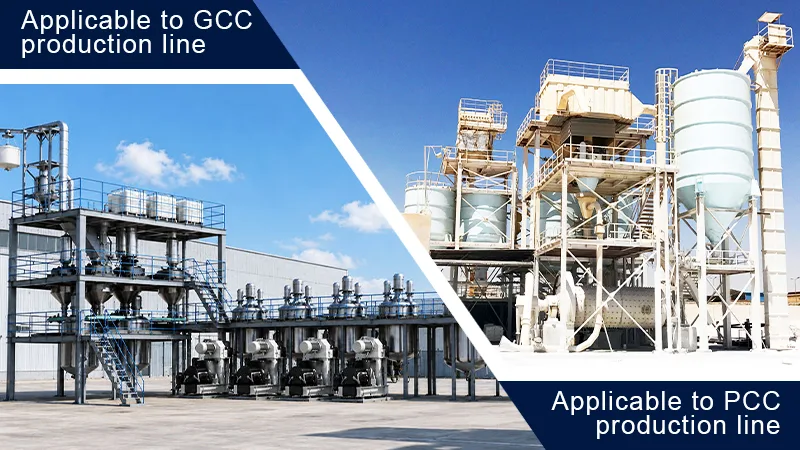
There are two main types of calcium carbonate used in the paper industry: Ground Calcium Carbonate (GCC) and Precipitated Calcium Carbonate (PCC). Both GCC and PCC can be used as internal pulp fillers and surface coating pigments in paper manufacturing.
Ground Calcium Carbonate (GCC)
GCC is produced by mechanically grinding natural limestone, calcite, or marble through a complete calcium carbonate grinding plant. It features high whiteness, stable chemical properties, good dispersibility, and relatively low production cost. It is the most widely used paper filler calcium carbonate type in the paper industry.
It is widely used in the production of ordinary printing paper, writing paper, and office paper, both as internal filler and coating pigment.
👉 GCC is the most widely used calcium carbonate powder for paper filler applications due to its cost efficiency and stable performance in large-scale paper production.
Precipitated Calcium Carbonate (PCC)
PCC is produced through chemical precipitation. Its particle size, crystal form, and morphology are easier to control. Therefore, it has advantages in improving opacity, optimizing optical properties, and meeting the requirements of special paper grades.
PCC is commonly used in high-grade printing paper, specialty paper, and paper coating applications where higher optical performance is required.
👉 PCC is especially preferred in high-end paper mills in Europe and North America where optical performance requirements are higher for coated paper production.
Two Main Applications of Calcium Carbonate in Papermaking
1. Internal Pulp Filler
Replaces part of wood pulp fiber and reduces raw material cost
Improves paper opacity and reduces print show-through
Enhances paper brightness and whiteness
Increases paper bulk and stiffness
Improves dewatering efficiency and increases production efficiency
Widely used in paper filler calcium carbonate applications in paper mills
2. Surface Coating Pigment
Improves paper gloss and smoothness for coated paper
Enhances ink receptivity and color reproduction
Stabilizes coating rheology in paper coating systems
Partially replaces titanium dioxide (TiO₂), reducing cost while maintaining whiteness
Used in high-grade paper coating pigment production lines
Complete Calcium Carbonate Powder Production Process
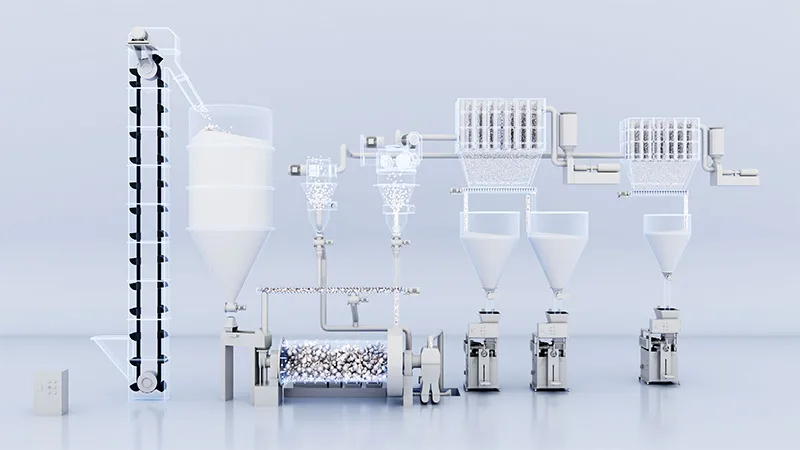
The Daswell Powder calcium carbonate grinding plant for paper industry adopts a modular design, covering the full process from raw material feeding to final packaging.
Stage 1: Crushing
The purpose of crushing is to reduce large raw materials such as limestone, calcite, or marble into a feed size suitable for grinding (typically ≤25 mm), ensuring stable operation of the calcium carbonate grinding system.
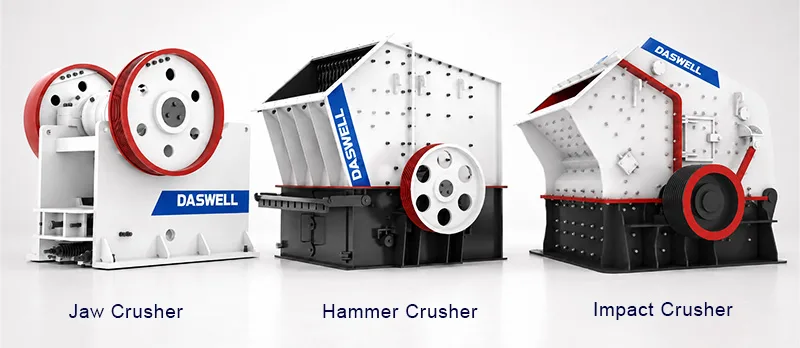
Daswell can provide the following crushing equipment for calcium carbonate processing plants:
- Jaw Crusher: suitable for primary crushing, large feed size, high capacity, commonly used for limestone and medium-hard materials in GCC production line
- Hammer Crusher: suitable for medium-soft materials, high reduction ratio, fewer crushing stages required
- Impact Crusher: suitable for applications requiring better particle shape in mineral powder production
More uniform raw material size leads to more stable grinding performance and easier control of final product fineness in paper grade calcium carbonate production.
Stage 2: Conveying and Feeding
After crushing, materials are lifted by a bucket elevator to the storage silo, then evenly and quantitatively fed into the grinding chamber via a vibrating feeder.
Stable feeding is essential for consistent paper grade calcium carbonate powder fineness and also helps reduce equipment wear and energy consumption in grinding plants.
Stage 3: Grinding
Grinding is the core process of the entire calcium carbonate powder for paper industry production line, directly determining powder fineness, particle size distribution, and whiteness.
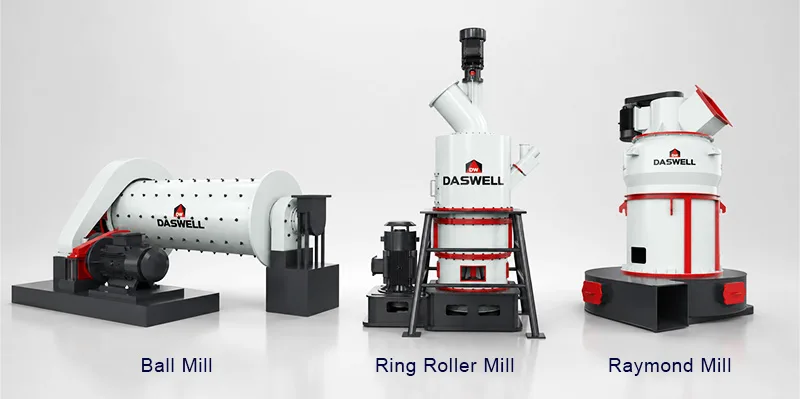
- Raymond Mill
Raymond mill adopts a vertical structure with an integrated classifier. The product fineness is relatively uniform, with a pass rate up to 99%. The electrical system can be centrally controlled.
It is suitable for producing standard filler-grade or basic industrial-grade calcium carbonate powder for paper filler applications.
- Ring Roller Mill
The ring roller mill is equipped with a high-precision built-in classifier, achieving narrow particle size distribution and stable fineness control. It is suitable for medium- and high-grade calcium carbonate production for paper coating and paper filling applications.
It is widely used for printing paper, advertising paper, and coating paper filler applications, and is widely used in paper production line mineral filler systems.
- Ball Mill
Ball mills achieve grinding through impact and rolling of grinding media inside a rotating cylinder. They offer strong adaptability and can be used for both dry and wet grinding in calcium carbonate processing plants.
- Dry ball mill system: suitable for large-capacity production of medium to fine calcium carbonate powder for paper industry
- Wet ball mill system: suitable for producing calcium carbonate slurry for paper coating applications with high dispersion requirements
For paper applications requiring high whiteness, ceramic liners can be used in ball mills to reduce iron contamination and ensure high-purity paper grade calcium carbonate powder.
Stage 4: Classification
Classification accuracy directly affects particle size distribution, which is a key parameter for paper manufacturers selecting calcium carbonate for paper coating and filling.
Daswell can equip high-efficiency turbo classifiers with German NG-classifier wheel technology for precise calcium carbonate powder classification.
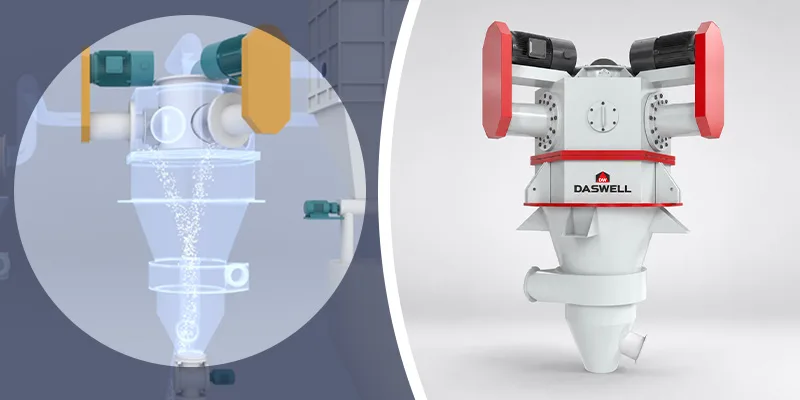
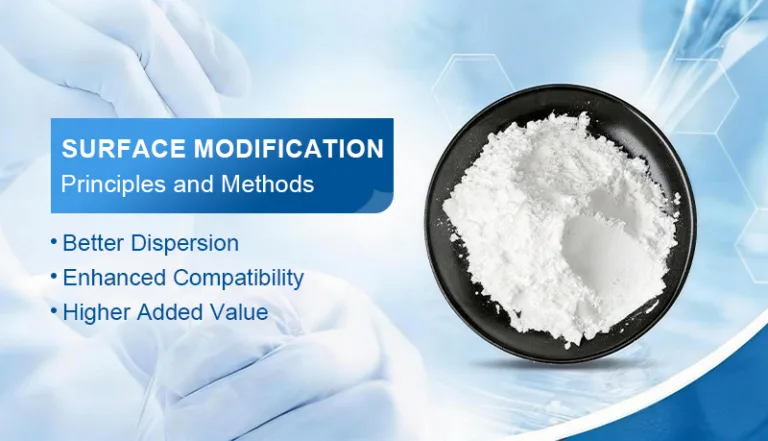
Stage 5: Surface Modification
Surface modification is an optional process in paper coating calcium carbonate production systems.
In paper coating applications, more attention is usually given to particle size distribution, slurry dispersion stability, whiteness, viscosity, and abrasion value.
Daswell provides a high-speed vortex modification machine for calcium carbonate surface treatment in mineral powder processing plants.
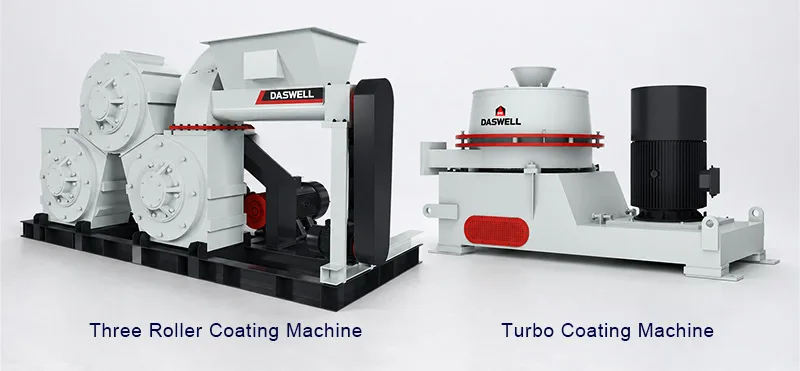
Stage 6: Dust Collection and Recovery
The dust collection system ensures environmental compliance and powder recovery in calcium carbonate grinding plants for paper industry applications.
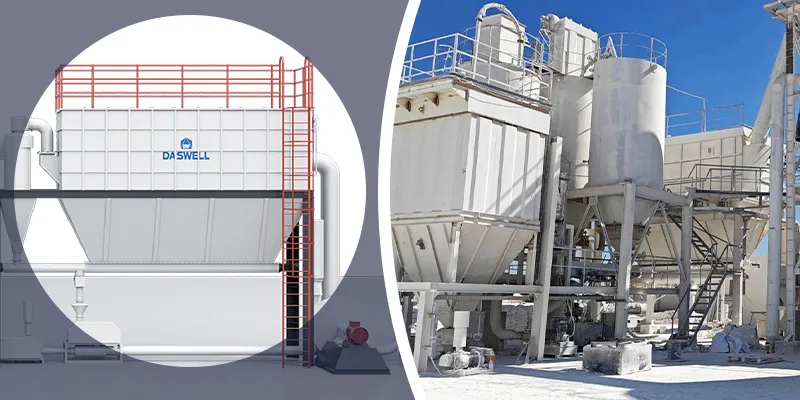
Stage 7: Automatic Packaging
Final paper grade calcium carbonate powder is automatically packaged into 25 kg bags or 1000 kg jumbo bags for global shipment.
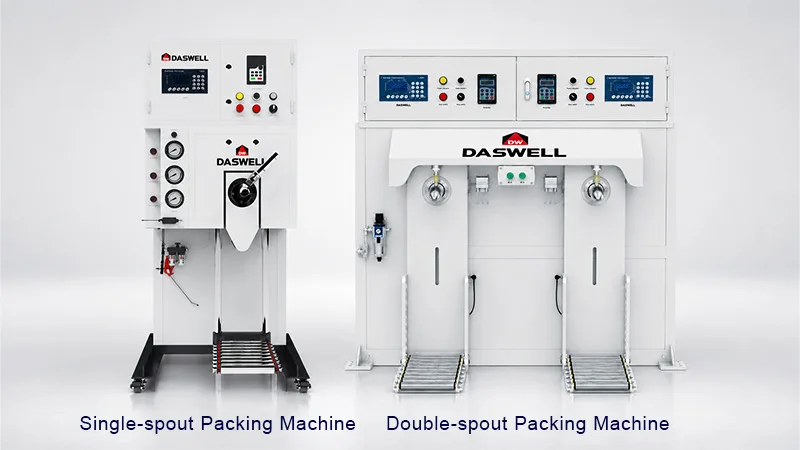
Common Daswell Calcium Carbonate Grinding Solutions for Paper Industry
| Paper Application | Target Fineness | Recommended Main Equipment | Auxiliary Configuration |
|---|---|---|---|
| Ordinary paper filler (writing paper, office paper) | D97 around 45 μm | Raymond Mill | Jaw crusher + classifier + dust collection + packing |
| Medium to high-grade paper filler (printing paper, advertising paper, coated paper) | D97 10–20 μm | Ring Roller Mill + Turbo Classifier | Jaw crusher + optional surface modification + dust collection + packing |
| High-end paper coating slurry (coated paper, inkjet paper, specialty paper) | D97 ≤ 5 μm | Wet ball mill system + stirred mill | Slurry preparation tank + screening + mixing storage tank |
Daswell can design a complete calcium carbonate grinding plant for paper industry based on raw material conditions, target fineness, capacity requirements, and application purpose.
Contact Us
If you are planning to build or upgrade a calcium carbonate powder for paper industry production line, welcome to contact DaswellPowder. We can provide customized solutions for GCC and PCC paper filler and coating applications based on your raw material conditions, target fineness, and capacity requirements.