
Air Classifier Working Principle: How Does It Control Powder Fineness?
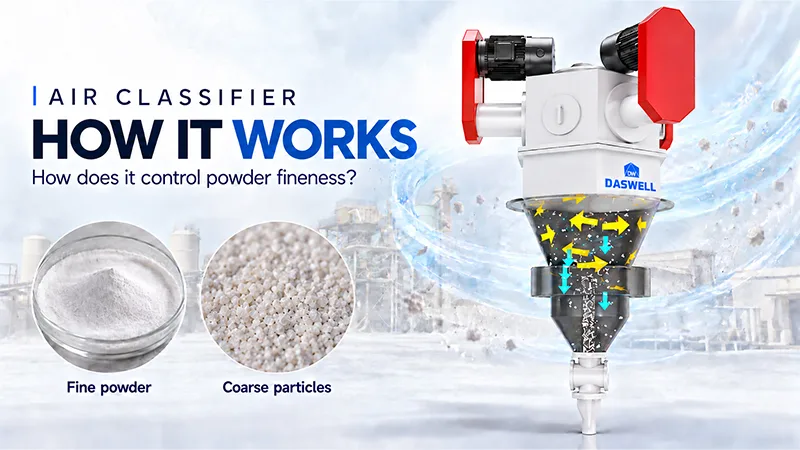
An air classifier separates fine powder from coarser particles by taking advantage of differences in how particles move in an airflow. In mineral powder production, it often works alongside grinding equipment to control the particle size distribution of the finished product.
Classification performance depends on classifying wheel speed, airflow rate, feed rate, and material properties.
What Is an Air Classifier?
An air classifier uses airflow and differences in particle motion to separate powder into different size fractions. Particle size is a key factor, but particle density, shape, airflow conditions, and equipment design also influence separation.
Grinding equipment reduces particle size, while a classifier separates the resulting particles. In calcium carbonate powder production, for example, an air classifier separates powder that meets the target fineness from coarser particles.
To learn how the two machines work together, see our ball mill and air classifier selection guide.
How Does an Air Classifier Work?
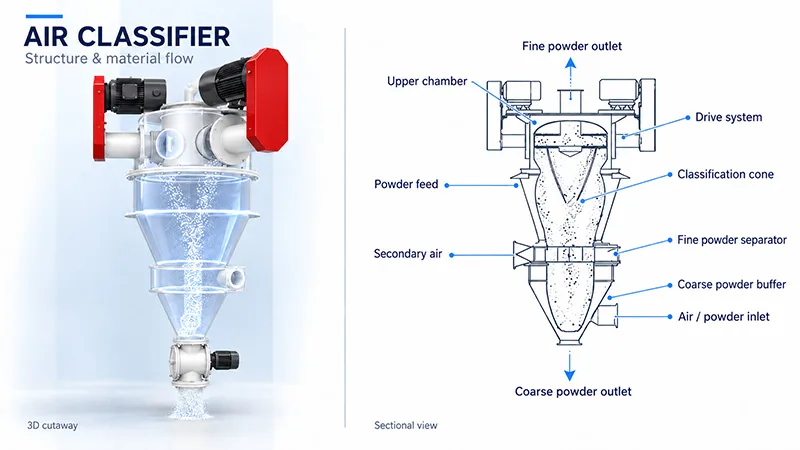
A dynamic air classifier typically uses airflow and a high-speed rotating classifying wheel to separate particles. The process has four main stages.
Step 1: Powder Enters the Classification Zone
Powder enters the machine and disperses in the classification zone. Uneven feeding or particle agglomeration can affect how well the particles separate.
Step 2: Airflow and the Classifying Wheel Act on the Particles
The airflow exerts drag on the particles, while the rotating classifying wheel creates a centrifugal effect. Finer particles generally follow the airflow more readily, while coarser particles are more strongly affected by centrifugal action.
Step 3: Fine and Coarse Particles Separate
Fine particles that pass through the classification zone travel with the airflow to the collection system. Coarser particles are rejected from the fine powder stream.
Step 4: Fine Powder Is Collected and Coarse Powder Is Discharged
Fine powder is typically collected by a cyclone separator, bag filter, or other collection equipment. In a closed-circuit grinding system, the separated coarse powder can return to the mill for further grinding.
How Does an Air Classifier Control Powder Fineness?
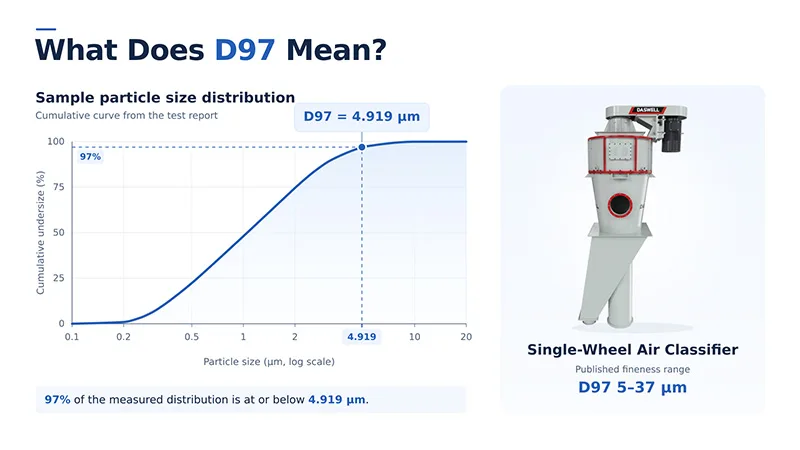
Finished powder fineness is mainly affected by classifying wheel speed, airflow rate, feed rate, and material properties.
▹Classifying Wheel Speed
With other conditions kept largely unchanged, increasing the classifying wheel speed generally strengthens the centrifugal effect. This reduces the cut size and tends to produce finer powder.
▹Airflow Rate
Airflow rate affects the drag acting on particles and the flow conditions within the classification zone. Changes in airflow can therefore alter both the cut size and classification performance.
▹Feed Rate
An excessive feed rate can increase the particle load in the classification zone and interfere with separation. Even if the classifying wheel speed remains unchanged, the finished product’s particle size distribution may shift.
▹Material Properties
Particle density, shape, moisture content, and tendency to agglomerate all influence particle movement in the airflow.
| Factor | Potential Effect | What to Check |
|---|---|---|
| Classifying wheel speed | Changes the cut size and product fineness | Monitor both fineness and output |
| Airflow rate | Changes particle movement and classification conditions | Follow the equipment’s recommended operating range |
| Feed rate | Changes the particle load in the classification zone | Keep feeding stable |
| Material properties | Affect particle movement and separation | Check the raw material conditions |
After adjusting the settings, check the finished product’s particle size and output before deciding whether further changes are needed.
What Is D97, and How Does It Relate to Air Classification?
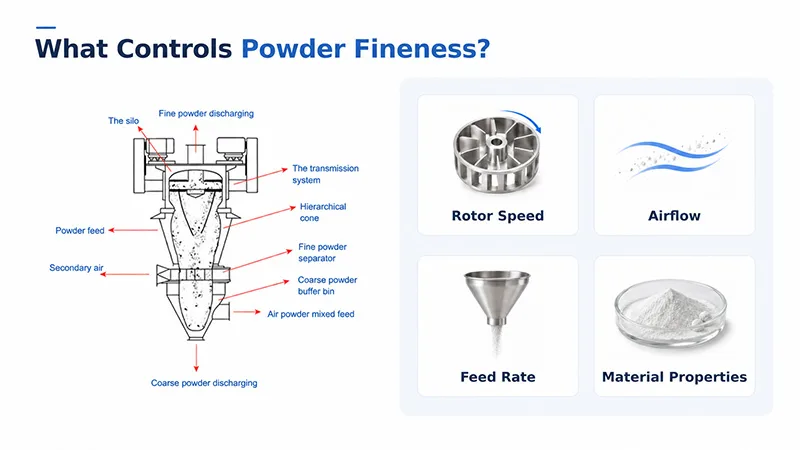
D97 is a commonly used indicator of powder particle size distribution. For example, D97 = 10 μm means that approximately 97% of the measured distribution falls at or below 10 μm, according to the measurement method and reporting basis used.
The remaining approximately 3% is larger than 10 μm. Those particles are not necessarily concentrated close to 10 μm.
D97 describes the coarse end of the distribution, but it does not describe the entire particle size distribution curve. Actual classification performance also depends on raw material properties, equipment configuration, operating conditions, and system capacity.
Single-Wheel Air Classifier Fineness Range
Daswell’s Single-Wheel Air Classifier has a listed product fineness range of D97 5–37 μm, with its best performance in the D97 8–25 μm range. The suitable operating range for a particular application must be confirmed based on the material and equipment configuration.
Why Does Air Classifier Product Fineness Become Unstable?
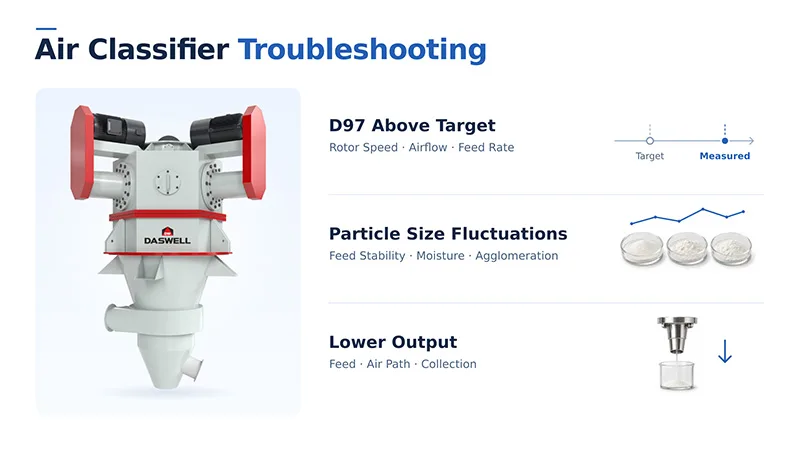
▹Product D97 Is Higher Than the Target
Check whether the classifying wheel speed, airflow rate, or feed rate has changed. Also check whether the current operating settings are suitable for the raw material being processed.
Do not increase the classifying wheel speed without first investigating the cause.
▹Particle Size Distribution Fluctuates
Check for uneven feeding and changes in the raw material’s moisture content, agglomeration, or particle size distribution.
Keeping a record of operating settings and particle size test results can help identify what is causing the fluctuations.
▹Finished Product Output Falls
Check the feed system, airflow path, collection system, and equipment operating condition.
If you adjust the settings to produce finer powder, monitor output as well. Finer product requirements may come at the expense of capacity, depending on the material and equipment configuration.
How Do You Choose the Right Air Classifier?
Choosing an air classifier requires more than a target fineness. You also need to consider raw material properties, required output, and how the classifier will work with the grinding equipment and collection system.
Shortlist Classifier Types by Target Fineness
For a target fineness around D97 3–10 μm, particularly where precise classification is required, a Turbo Classifier is an option to evaluate.
For applications mainly within D97 8–25 μm that require high feed capacity, a single-wheel air classifier may be suitable.
These ranges provide an initial basis for selection. The final choice must also account for raw material properties, required output, actual classification performance, and the production line configuration.
Contact Daswell Powder
Before selecting a classifier, prepare the following information:
- Material type: For example, calcium carbonate, quartz, talc, or feldspar powder.
- Target fineness: The target D97 and any other particle size requirements.
- Required output: The finished product output needed at the target fineness.
- Existing process: Whether the line already includes a ball mill, ring roller mill, or other grinding equipment.
- End application: How the finished powder will be used and the particle size requirements it must meet.
If you are planning a mineral powder production line, contact Daswell Powder. Our team can assess a suitable air classifier and process configuration for your application.