
Air Jet Mill Working Principle: How Does a Jet Mill Grind Materials?
If you are selecting equipment for an ultrafine powder project, you may have come across the terms “air jet mill,” “jet mill,” and “jet pulverizer.” Many customers ask the same question when they first encounter this equipment: without grinding balls, rollers, or hammers, can compressed air alone really reduce a material to micron size?
Yes, it can. Strictly speaking, however, the air does not “cut” the material like a blade. The compressed gas is accelerated through nozzles and carries the particles to very high speeds. Inside the grinding chamber, the particles collide with one another and are subjected to impact and shear. They are eventually broken into smaller particles.
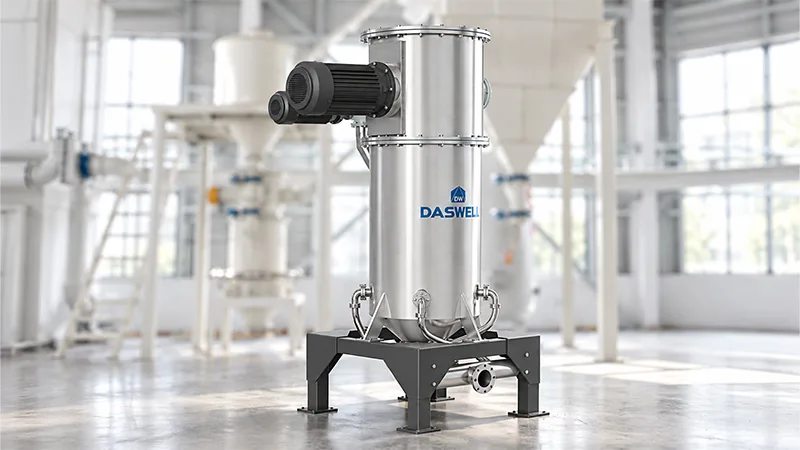
How Does an Air Jet Mill Grind Materials?
A complete air jet milling system generally involves five stages: Compressed-air purification and drying → nozzle acceleration → interparticle collision and grinding → dynamic classification → cyclone and bag-filter collection.

Why Does Adjusting the Classifier Wheel Change Product Fineness?
In the classification zone, particles are affected by both the drag force of the airflow and the centrifugal force generated by the classifier wheel. Finer and lighter particles can pass through the classifier wheel more easily. Coarser particles are returned to the grinding zone.
In general, a higher classifier wheel speed produces a finer cut size. Actual product fineness is also affected by the following factors:
- Grinding-gas pressure and flow rate;
- Classifier wheel speed;
- Feed rate and feeding stability;
- Material hardness, brittleness, and toughness;
- Feed size and moisture content;
- Target particle size and the permitted particle size distribution.

What Equipment Is Included in a DaswellPowder Air Jet Mill Production Line?
A standard DJM air jet mill production line generally includes an air compressor, air receiver tank, filters, refrigerated air dryer, controlled feeding system, jet mill, dynamic classifier wheel, cyclone collector, bag filter, induced draft fan, and electrical control system.
Main Technical Specifications of the DJM Series
| Model | Compressed Air Consumption (m³/min) | Operating Pressure (MPa) | Feed Size (mm) | Product Size (μm) | Capacity (kg/h) | Main Unit Power (kW) | Auxiliary Power (kW) |
|---|---|---|---|---|---|---|---|
| DJM-02 | 2 | 0.85 | <2 | 1–150 | 0.2–2 | 4.5 | 17 |
| DJM-03 | 3 | 0.85 | <3 | 1–150 | 5–15 | 8 | 24 |
| DJM-06 | 6 | 0.85 | <3 | 1–150 | 10–50 | 12 | 40 |
| DJM-10 | 10 | 0.85 | <3 | 1–150 | 30–150 | 15 | 79 |
| DJM-20 | 20 | 0.85 | <3 | 1–150 | 100–400 | 26 | 136 |
| DJM-40 | 40 | 0.85 | <3 | 1–150 | 300–1000 | 40 | 260 |
The data above are provided for preliminary model selection. Actual capacity and achievable product fineness depend on the material properties, feed condition, target particle size, and operating conditions. Final specifications are subject to material testing and the confirmed technical proposal.
Which Materials Are Better Suited to Air Jet Milling?
An air jet mill is generally more suitable for the following requirements:

- Micron-sized or finer powder is required, with strict control over the upper particle size limit;
- Contamination caused by wear of grinding balls or other grinding media should be avoided;
- The material is sensitive to temperature rise;
- The product has a relatively high added value and can justify the energy consumption of compressed gas;
- Processing must take place in an enclosed system, with special requirements for the process gas or product purity.
The DJM series can be used for certain non-metallic minerals, fine chemical materials, advanced materials, food ingredients, and functional powders.
Abrasive materials such as quartz and silica can also be processed. However, wear of product-contact parts, wear-resistant linings, and final product purity must be carefully evaluated. Whether ceramic, zirconia, or another wear-resistant solution is suitable should be determined through material testing.
What Are the Advantages of an Air Jet Mill?
The main advantages of an air jet mill include:
- No grinding balls or rollers are used, reducing the risk of contamination from grinding-media wear;
- Gas expansion at the nozzles provides a cooling effect, which helps limit the temperature rise during grinding;
- Dynamic classification discharges qualified fine powder promptly and helps control product particle size;
- The system can operate in an enclosed configuration, which facilitates dust control and the design of special-gas processes;
- Different product-contact materials and wear-protection solutions can be selected for abrasive or high-purity materials.
For these reasons, a jet mill machine is better suited to products that require close control of fineness, purity, or processing temperature.

What Information Is Needed Before Selecting an Air Jet Mill Model?
- Material name, composition, and application;
- Feed size, moisture content, hardness, brittleness, and abrasiveness;
- Target particle size;
- Required capacity;
- Limits on iron contamination, whiteness, or other purity indicators;
- Whether the material is flammable, easily oxidized, hygroscopic, corrosive, or heat-sensitive;
- Whether several particle size fractions are required at the same time.
DaswellPowder supplies DJM series air jet mills and complete production lines. If you are looking for a reliable air jet mill, we can customize a suitable solution for your material and production requirements.
Learn more about the equipment: DaswellPowder Air Jet Mill