
How to Choose Ball Mill and Air Classifier for Mineral Powder Grinding?
A ball mill and air classifier system is widely used for fine mineral powder grinding. Different raw materials have different hardness, abrasiveness, density, purity requirements, and grinding characteristics. Besides, powder manufacturers have different production requirements for capacity, particle size, particle size distributions, and final applications.
Thus, it is key for you to choose both the ball mill grinder and the air classification machine. What you need to consider is the L/D ratio, size, grinding liner, grinding balls of the ball grinding mill, and the classifier type, classifying effects, power consumption, and investment.
A properly configured ball mill and air classifier system can help you balance production capacity, energy consumption, and equipment investment. Meanwhile, it also ensures stable powder quality.
How to Select Suitable Ball Mill Machine for Your Mineral Powder Grinding?
Ball mill is the main grinding equipment in the powder grinding line. Its configuration directly influences grinding capacity, energy utilization, wear, and final powder quality. When you select a ball mill for your business, there are several factors you should consider. Knowing these factors also helps you improve the ball mill grinding efficiency.
What Production Capacity Do You Need?
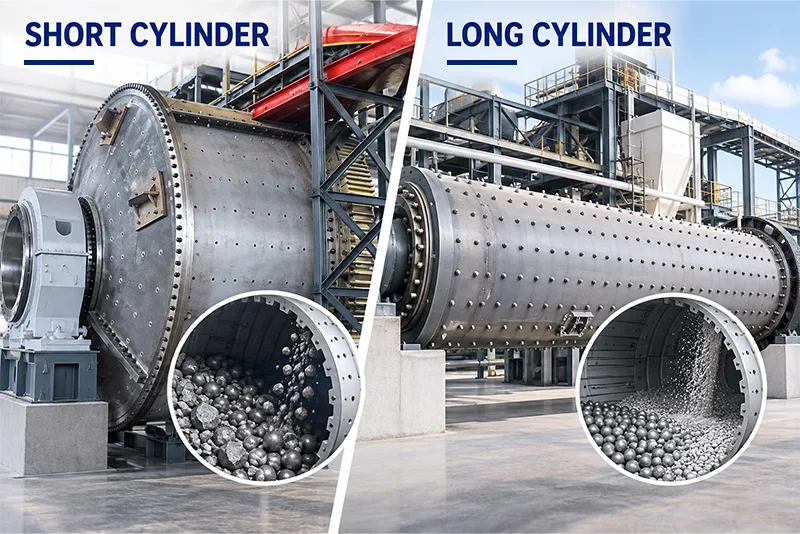
The production capacity is one of the most important factors when you choose a ball mill. Different cylinder diameters and lengths of ball mill machine means different grinding volumes and residence time. These affect the grinding effects.
Generally, the larger grinding chamber processes more material. The cylinder length influences the material remaining inside the grinding mill.
Therefore, to ensure the required grinding performance, we will customize the ball mill cylinder diameter and L/D ratio according to your required capacity, feeding size, and target fineness.
What Are the Raw Materials and Product Quality Requirements?
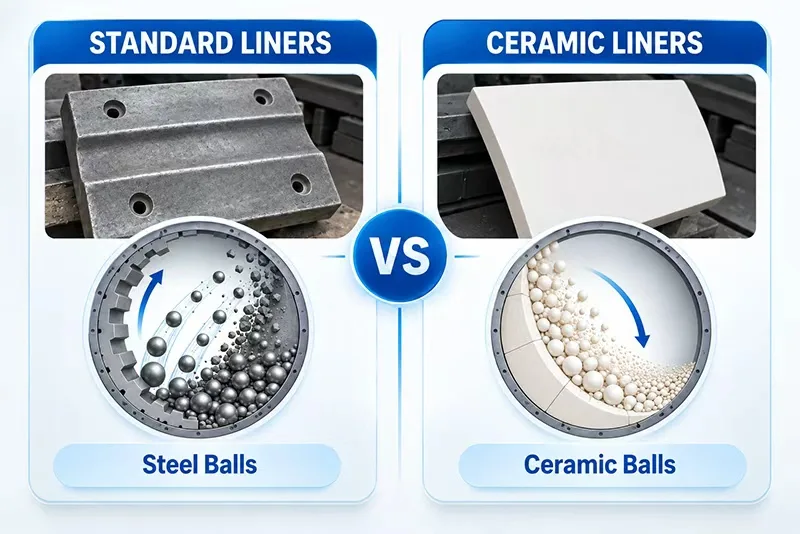
Different minerals have different wear and contamination requirements when grinding. You should select grinding liners and grinding balls according to the raw materials and product quality requirements.
For general mineral powder grinding, wear-resistant liners are suitable according to the material hardness and operating conditions. However, high-purity powders require more attention to contamination during grinding. For example, if you want to grind quartz, feldspar, calcined alumina, zircon sand, glass powder, silicon metal, and silicon carbide, they may have strict requirements for iron content, whiteness, or purity. For these ball mill applications, ceramic or other suitable non-metallic liners and balls are applicable for reducing contamination.
So, when you select the grinding liner and balls, you should consider both the raw material and the required quality of the finished powders.
What Grinding Media Should You Choose?
The materials of both the grinding media and the liner affect the level of contamination and wear. In addition, the size and size distribution of the grinding balls play an important role in grinding efficiency and final product fineness. When you select the grinding balls, you should choose ball sizes according to your specific grinding requirements.
The larger grinding balls provide stronger impact force. They are more suitable for relatively coarse feed materials or harder minerals. Smaller grinding balls provide more contact points. Thus, they are more effective for fine grinding.
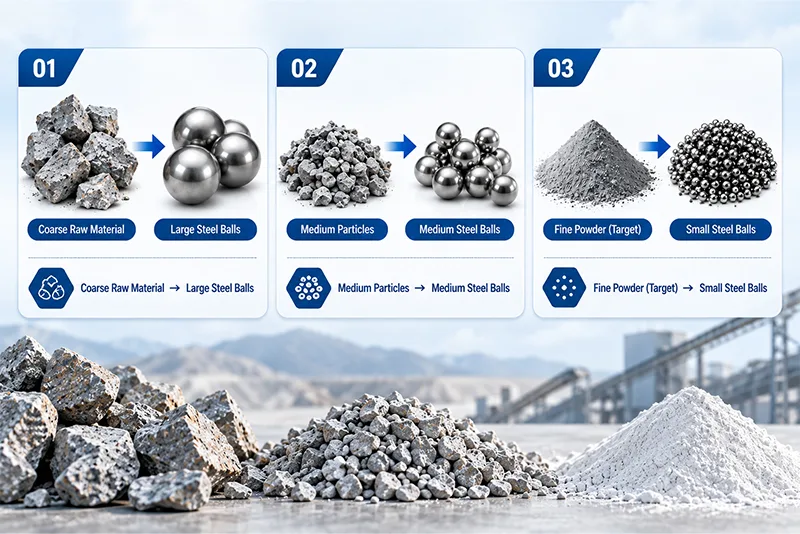
A suitable grinding ball size combination helps balance grinding force, efficiency, energy consumption, and final product fineness. Based on your feed size, material hardness, target fineness, ball mill size, and required capacity, we can customize the grinding ball size distribution for you.
Why Use the Air Classifier in Ball Mill Grinding Plant?
The two main functions of air classification machine are final particle size control and preventing over-grinding.
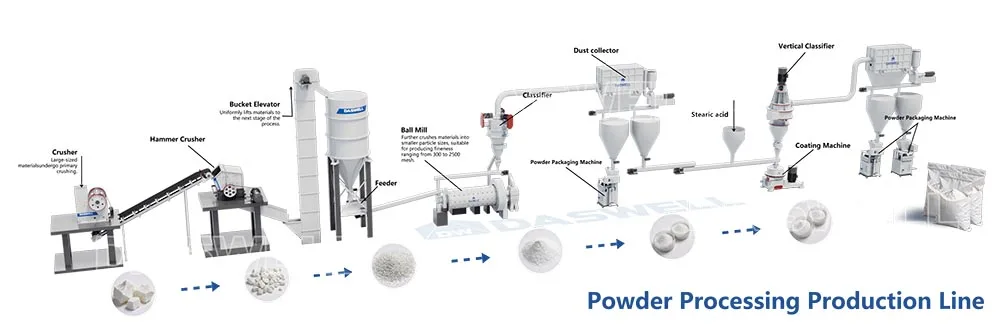
For the fine powder production, grinding mill cannot ensure stable particle size distribution. Combined with an air classifying machine, the ground particles enter the classifying system. It separates qualified fine particles from oversized particles. The qualified powders pass through the classifier and enters the collection system. The coarse particles will be returned to the ball mill for further grinding. This creates a closed-circuit grinding system.
Different air classifiers are suitable for different projects. According to your different requirements of product fineness, production capacity, energy consumption, and investment cost, you can match the most suitable air classifier.
How to Choose the Right Air Classifier?
When you select air classifier machine for your ball mill grinding plant, it should be selected together with the ball mill grinder, rather than as an independent machine. The classifier capacity should match the grinding capacity of the ball mill. Meanwhile, the classifier type should also be suitable for the target fineness and final powder application.
For most mineral powder grinding projects, vertical air classifiers and multi-rotor turbo classifiers are two main options.
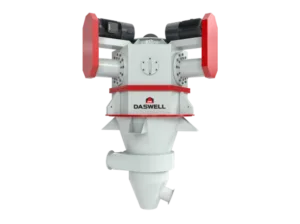
The multi-rotor air classifier is more suitable for finer powder and higher classification precision. It can be used for calcium carbonate, quartz, feldspar, talc, barite, graphite, activated carbon, silicon metal, silicon carbide, mica, and other materials.
Compared with the vertical classier, it can generally achieve finer classification and narrower particle size distribution. However, the equipment investment and total power demand are usually higher.

It is commonly used for calcium carbonate, quartz, feldspar, talc, calcined alumina, barite, glass powder, zircon sand, fly ash, brucite, and other mineral powders.
For your projects, which focus on high capacity, stable operation, and cost-effective fine powder production, the vertical air classifier is suitable. Its main advantages are relatively high output, simpler configuration, lower investment, and lower power demand.
How to Match the Ball Mill and Air Classifier?
When matching a ball mill with an air classifier, you should first determine the ball mill model. The ball grinding mill mainly determines the grinding capacity and how fine the material can be ground. The grinding mill size, L/D ratio, liner, and grinding media should be customized according to your specific production requirements.
The air classifier is then used to separate the qualified fine powders from the coarse particles. Its processing capacity should match the output of the ball mill to ensure the whole grinding system can operate continuously and efficiently.
In general, the ball mill and classifier matching configuration mainly depends on the balance between production capacity and product fineness.
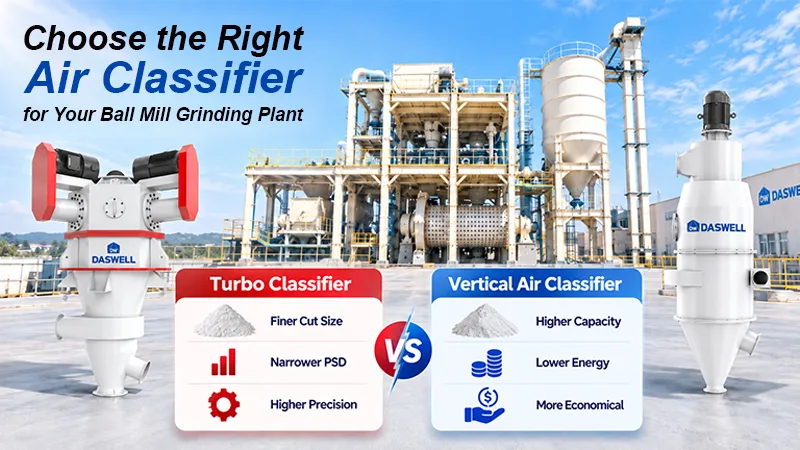
| Production Requirement | Recommended Configuration | Main Advantage |
| Higher capacity with moderate fineness requirements | Ball mill + vertical air classifier | Higher throughput, lower energy consumption, and more economical investment |
| Finer powder with higher classification precision | Ball mill + multi-rotor air classifier | Finer cut size and narrower particle size distribution |
Contact Daswell Powder and send us your raw material, required capacity, feed size, and target fineness. We can customize a complete mineral powder grinding plant according to your production requirements.