
Bead Mill for Wet Grinding Applications Across Different Industries
Solid raw materials, such as the active ingredients in pesticides or pigments, often require grinding before they enter the production process,then in order to meet the requirements for particle fineness and dispersion state in the final product.
By using the high-speed movement of grinding beads within a slurry, bead mills achieve particle refinement and dispersion; consequently, they are widely used in industries such as agrochemicals, inks, pigments, and coatings.
From the initial preparation of the slurry to the final precision-grinding stage, bead mills play a vital role in these manufacturing processes.
What is wet grinding?
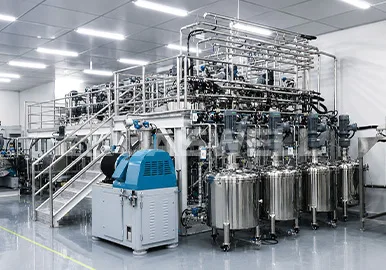
Wet grinding is a processing method in which solid particles are refined within a liquid medium.During production, solid raw materials are mixed with water, solvents, or other suitable liquids to form a slurry with a certain degree of fluidity, which is then processed using specialized grinding equipment.
This process is commonly used in industrial production where the control of particle size and dispersion state is required. For instance, pigments, active ingredients in pesticides, and certain mineral raw materials typically undergo a degree of size reduction before being incorporated into final products.
Process of Wet Grinding
01 Material and Slurry Preparation
Prepare the raw materials and liquid medium according to the required proportions. Some materials may need to undergo coarse crushing, screening, or pre-mixing, followed by a blending process to produce a slurry with a specific degree of uniformity.
02 Feeding and Particle Grinding
Once the slurry enters the grinding equipment via a pumping system, the solid particles are gradually refined through mechanical action.
03 Media Separation and Discharge
After grinding, the grinding media are separated from the slurry, depending on the equipment configuration. If the product requires a finer particle size, multiple grinding passes or a recirculation process may be necessary.
How does a bead mill achieve wet grinding?
A bead mill is a type of wet grinding equipment that achieves particle size reduction through the movement of grinding beads. Unlike mill that relies solely on agitation for material mixing, a bead mill generates continuous mechanical action within its grinding chamber, allowing for the further processing of particles suspended in a slurry.
Its performance depends not only on the rotational speed of the rotor but also on the design of the grinding chamber, the grinding media used, the properties of the material, and the specific operating conditions.
Main Components of a Bead Mill
Grinding chamber
The grinding chamber is the primary step that mechanical interaction between the material and the grinding media takes place. Once the slurry enters, it flows through the grinding chamber, coming into full contact with the moving grinding beads.
Rotor
The rotor is a key moving component within a bead mill. When operation begins, the rotor rotates at high speed, driving the grinding media and keeping the grinding beads in a state of continuous motion within the grinding chamber.
Grinding media
Grinding media typically consist of beads made from zirconium oxide, glass, or other suitable materials. Driven by the rotor, these beads remain in constant motion, processing material particles through collision, compression, and shear forces.
Grinding media separation system
Separation systems typically employ a screen or other suitable structure that allows the slurry to pass through while retaining the grinding media within the grinding chamber.
Cooling system
Since mechanical heat is continuously generated during the grinding process, bead mills are typically equipped with a cooling system to manage the temperature within the grinding chamber. For temperature-sensitive materials, controlling the temperature rise during the grinding process is particularly important.
The grinding process inside a bead mill
01 Slurry enters the grinding chamber
The premixed slurry enters the grinding chamber via the feed system, where it comes into full contact with the grinding beads contained within, preparing it for the subsequent grinding process.
02 The rotor drives the movement of the grinding beads
Once the equipment is started, the rotor begins to rotate at high speed, driving the grinding beads to move continuously within the grinding chamber and creating a zone of sustained mechanical action.
03 Particles are subjected to mechanical action
As the slurry flows through the grinding chamber, the solid particles are subjected to impact, compression, and shear forces from the grinding beads, causing larger particles or agglomerates to be gradually refined.
04 Particles are progressively refined and dispersed
Through continuous grinding, the particle size and dispersion state of the material undergo gradual changes. The specific outcome depends on the material’s characteristics, the grinding media, and the operating conditions of the equipment.
05 Slurry is separated from the grinding beads
The milled slurry is discharged through a separation system, while the grinding beads remain within the grinding chamber to continue participating in the subsequent milling process.
Continuous Grinding and Recirculating Grinding
Continuous Grinding
Continuous grinding is a process in which slurry enters the equipment, passes through the grinding chamber, then being discharged.
This method is well suited for production lines with relatively stable feed and discharge conditions and high throughput requirements. The equipment can process material on an ongoing basis, which facilitates large-scale, continuous production.
Recirculating Grinding
Recirculation grinding involves returning the previously ground slurry back into the equipment for further processing.
This method is suitable for materials that require multiple passes through the grinding process to achieve the target fineness. Production personnel can use the results from sampling and testing to determine whether additional cycles of grinding are necessary.
Applications of Wet Grinding with Bead Mills Across Various Industries
The application range of bead mills is not just limited to any single type of industrial product. Whenever a production process involves the size reduction and dispersion of solid particles within a liquid medium, there is likely a need for wet grinding.
Wet grinding in pesticide production
Agrochemical production is a key application area for bead mills, particularly in the manufacturing of pesticide suspension concentrates. These concentrates are typically formulated using solid active ingredients—which are insoluble in water or other liquid media—combined with dispersants, wetting agents, and other additives to create a stable liquid preparation.
During the production process, the solid active ingredients must undergo thorough wetting, dispersion, and milling. Bead mills are commonly employed for this fine-milling stage. Once the pre-mixed slurry enters the grinding chamber, the grinding media exert continuous mechanical force on the solid particles, reducing them to the required particle size and achieving the desired state of dispersion.
Wet grinding in ink production
In the production of printing inks, wet milling is primarily used to refine pigment particles and improve their state of dispersion.
Pigments typically exist as solid particles. Because these particles tend to form agglomerates, the production process requires mixing the pigment with resins, solvents, water, or other liquid media, followed by further milling to enhance its dispersion.
Bead mills utilize the mechanical action of grinding beads to break down pigment agglomerates, resulting in finer pigment particles and a more uniform distribution within the liquid system.
Wet grinding in coatings production
Wet grinding in paint production primarily involves the processing of pigments and fillers. In paint formulations, pigments are typically used to provide color and opacity, while various types of fillers may be employed to adjust the coating’s mechanical properties, surface characteristics, and other functional attributes.
These solid raw materials require thorough dispersion within a resin, aqueous medium, or solvent system—a process with demanding requirements. Bead mills can be used to process pre-dispersed slurry, further refining the state of the pigment and filler particles.
Wet grinding in other industrial sectors
In the processing of ceramic materials, certain raw materials require wet-process refinement and dispersion to produce a slurry that meets the requirements for subsequent forming or processing stages. The state of the particles influences the slurry’s fluidity and its performance during downstream processing.
The production of battery materials also involves the wet-process dispersion and grinding of solid materials. Given the wide variety of battery materials, requirements regarding particle size modification, contamination during grinding, and the preservation of material properties can vary significantly from one material to another.
Furthermore, bead mills are also employed for particle refinement in the production of various fine chemicals, functional pigments, and other industrial slurries.
Wet Grinding Equipment in Mineral Processing
Non-metallic minerals such as ground calcium carbonate (GCC), kaolin, and talc are widely used in papermaking, coatings, and plastics. Applications requiring finer particles and specific size distributions often involve wet grinding.
Unlike pigments and agrochemical ingredients, mineral processing places greater emphasis on raw material hardness, initial particle size, throughput, and target fineness.
Wet grinding mills and bead mills serve different purposes. Bead mills focus on fine slurry grinding and dispersion, while mineral grinding equipment is configured according to the raw material and production requirements.
Key Aspects to Consider in Wet Grinding Operations
During the production process, there are several noteworthy operating conditions that affect both the grinding results and the operational status of the equipment.
Slurry viscosity and solids content
The viscosity and solids content of a slurry affect its fluidity, transport characteristics, and the mechanical action during the grinding process. Excessive viscosity increases resistance to pumping, while a solids content that is too low may reduce throughput.
Feed stability
Continuous fluctuations in feed rate can alter the grinding conditions within the equipment, thereby affecting processing performance and production continuity. Therefore, it is essential to ensure that the capacity of the conveying system is well-matched to that of the grinding equipment.
Grinding temperature management
For temperature-sensitive materials, the heat generated during the grinding process must be effectively controlled. During production, appropriate cooling conditions should be established based on the material’s characteristics, and the temperature of the slurry should be closely monitored.
Inspection of grinding media and separation systems
Grinding media undergo wear during long-term operation. Regularly inspect the separation system for clogs, wear, or other irregularities to prevent any adverse impact on material discharge and equipment operation.
Equipment cleaning and maintenance
When a manufacturing enterprise needs to switch between different materials or formulations, residues from the previous batch may remain inside the equipment. If cleaning is inadequate, this can lead to the contamination of subsequent products.
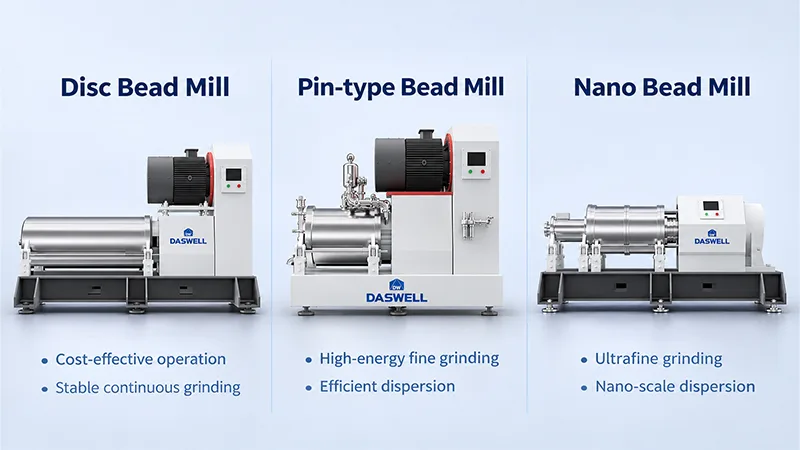
If you are seeking bead mil for the fine grinding of industrial slurry, consider exploring the sand mills offered by DASWELLPOWDER. For projects primarily involving the wet grinding of non-metallic minerals, we invite you to explore our wet grinding equipment. Please contact us to learn more about its specific range of applications and the processing solutions we can provide.