
How to Produce Plastic Grade Ground Calcium Carbonate for Plastic Applications?
Plastic products are everywhere in our daily life. From shopping bags to takeaway containers to water pipes, automotive interiors, all of them have an essential industrial mineral filler: Ground Calcium Carbonate(GCC).
In the plastic industry, GCC is one of the most widely used fillers. It offers high whiteness, abundant reserves, stable chemical properties, and cost advantages. Especially, using GCC for plastic manufacturing, it reduces the resin consumption, improves product performance, and lowers the production costs.
While, not all the calcium carbonate powders are suitable for plastic applications. Different plastic products have different requirements on the GCC particle sizes, purity levels, surface treatment, and performance indicators.
Do you know the quality requirements for plastic-grade GCC? And which grinding line is suitable for you to manufacture these powders?
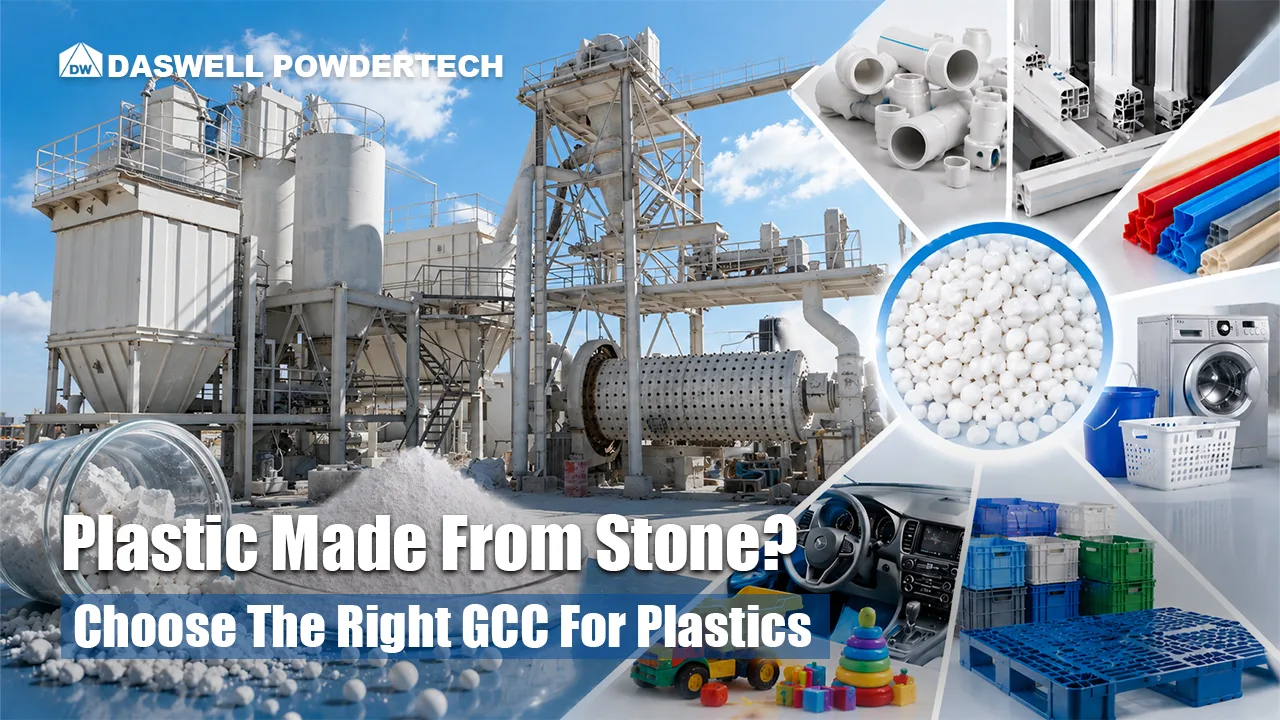
What is Plastic Grade Ground Calcium Carbonate?
Ground calcium carbonate is produced by mechanically grinding natural minerals into fine powders. The commonly used materials include limestone, chalk, marble, or calcite. In plastic manufacturing, the GCC is not only used as a low-cost filler but also as a performance-enhancing material.
The main functions of plastic-grade GCC include:
In some plastic products, calcium carbonate loading can exceed 50%. This makes it one of the most cost-effective functional fillers in the plastic industry.
5 Key Quality Requirements for Plastic Grade GCC
According to the plastic industry standard for ground calcium carbonate, there are several important indicators you should know. They determine whether GCC powder is suitable for plastic applications or not.
The whiteness directly affects the appearance and color performance of plastic products.
Generally, for ordinary plastic products, GCC whiteness should exceed 92%. For high-end plastic applications, especially for the white plastic products and premium films, the whiteness above 95% is better.
If you use the low-whiteness powders, it may lead to poor product appearance and color inconsistency.
Purity is critical in plastic applications. Some impurities can negatively affect the powders both during processing and final product performance:
Thus, for the plastic filler applications, high-purity calcite-based GCC is often popularly used.
Many manufacturers think that the finer the powder, the better the performance. However, GCC particle size should match the target plastic application. Different mesh sizes are applicable for different industries.
| Plastic Product / Application | Typical GCC Fineness | Recommended Dosage | Main Purpose / Benefits |
| PP Woven Bags & Packing Straps | 400 mesh | 20–30% | Reduce material cost while maintaining rigidity and processing stability |
| PE Film (Shopping Bags, Agricultural Film, Carry Bags) | 1250 mesh | 5–30% | Improve film stiffness, reduce resin cost, maintain processability and acceptable transparency |
| PVC Pipes | 800–1250 mesh | 30–60% | Improve rigidity, dimensional stability, and cost efficiency |
| BOPP Food Packaging Film | ≥2000 mesh | 7–25% | Improve dispersion, surface quality, and film performance |
| Breathable Diaper Film | ≥2000 mesh | 40–60% | Improve microporous structure, breathability, and cost performance |
| Automotive Plastics (Interior & Exterior Parts) | 1500–2000 mesh | 8–30% | Enhance stiffness, dimensional stability, and mechanical performance |
| Home Appliance Plastic Housings (PP, ABS, PS, PC/ABS) | 2000–2500 mesh | 5–25% | Improve surface smoothness, rigidity, and product appearance |
In the current market, 400-800 mesh GCC powders account for most bulk filler demand. The ultrafine powder, which is above 1250 mesh is increasingly used in high-value plastic applications.
Oil adsorption value is another important parameter. High oil absorption means the powder absorbs more plasticizer and resin. This increases formulation cost and processing difficulty.
Generally speaking, lower oil absorption is better. Through surface modification, the oil absorption value will be reduced. And it can improve compatibility with polymers.
Moisture is an important factors for GCC powder production, which often be overlooked. If there are excess moisture or volatile substances, it may lead to:
For ensuring the stable plastic processing, your GCC powder should maintain moisture content.
Which Grinding Mill is Suitable for Your Plastic Grade GCC Production?
Daswell Powder Technology has been offering complete GCC powder processing solutions for over 15 years. Whether for fine powder grinding or powder surface coating, we have various production lines for your reference. Especially, we offer grinding aids for higher production efficiency. For your various fineness requirements, there are different types of grinding mills for you to choose.
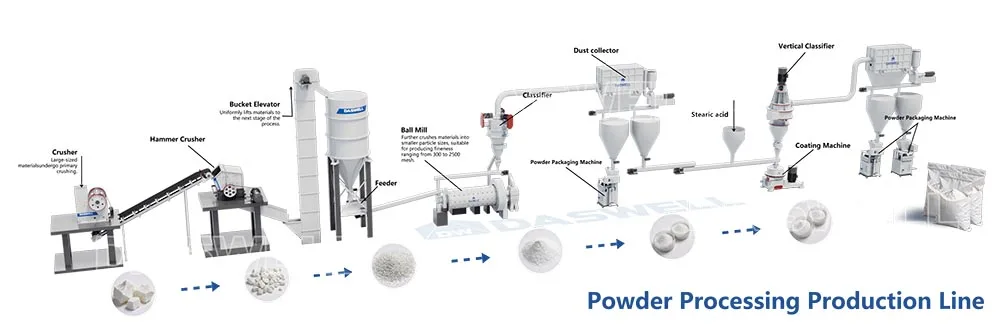
Ball mill grinding with classifier for ultrafine powder
For the premium plastic applications, which require ultrafine powder above 1250 mesh, especially 2000-3000 mesh products, this solution is ideal. It is suitable for BOPP films, breathable membrane materials, PP nonwoven fabric, high-end functional plastics.
Our ball mill grinding solution offers adjustable particle size distribution, high output capacity, stable ultrafine powder production, and excellent classification accuracy.
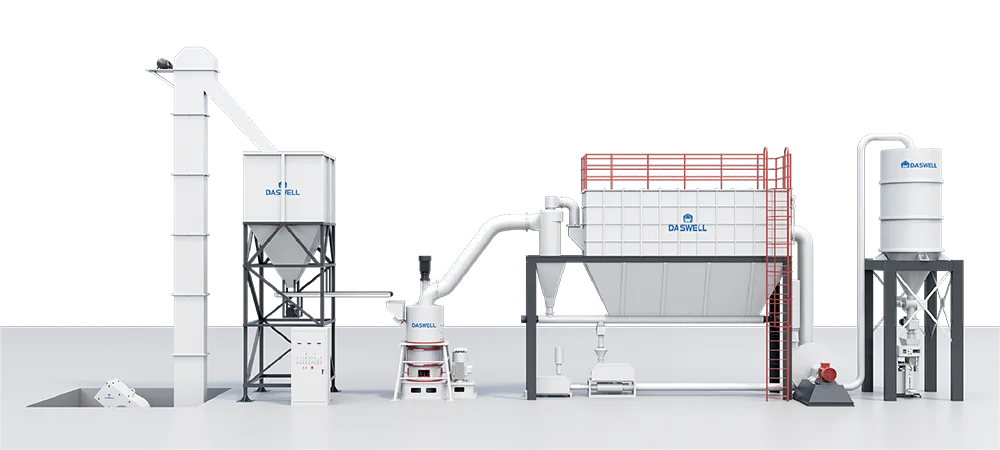
Ring roller grinding mill for 800-2500 mesh GCC
For the medium and ultrafine GCC powder, a ring roller mill offers excellent energy efficiency and stable fineness control. It has a built-in classifier. This system is widely used for PVC pipe fillers, PE film fillers, Automotive plastics, Appliance plastics.
Compared with ball mill grinding solution, its energy consumption is lower.
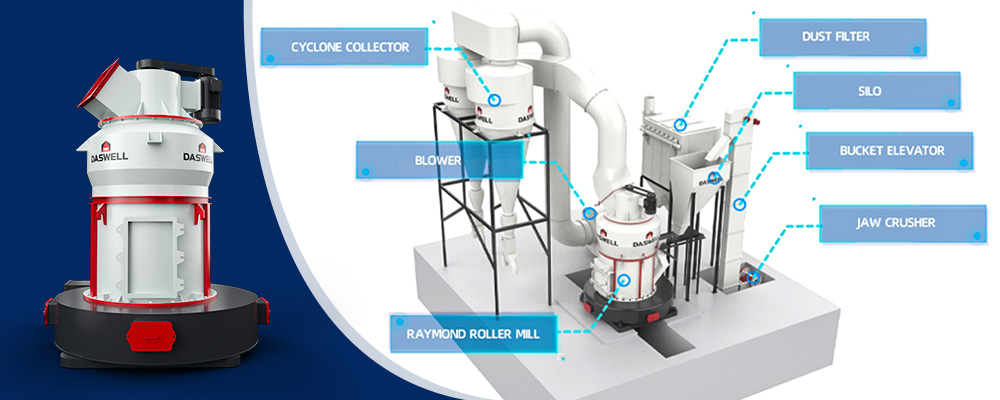
Raymond mill for 80-800 mesh GCC production
For coarse and medium-fine GCC powders, a Raymond mill is an economical and reliable solution. It is suitable for PP woven bags, packing straps, standard plastic fillers.
This machine has a compact structure, stable operation, and low investment cost. Meanwhile, it is easy for you to maintain it.
At Daswell Powder Tech., we provide more than a grinding machine. We deliver complete GCC production solutions, including:
Crushing → Grinding → Classification → Surface Modification → Packing
According to your target plastic market, required mesh size, and production capacity, we can recommend customized solutions for you. Our solutions cover pre-grinding, grinding line, coating line for surface modification, and automatic packing systems.
Whether you are producing GCC for PVC pipes, shopping bags, BOPP films or some other plastics,, choosing the right grinding process is the key to maximizing product value and plant profitability. Contact Daswell Powder to build your more efficient, energy-saving, and high-value plastic-grade GCC production line.