
How to Produce Toothpaste-Grade Calcium Carbonate?
Every day, billions of people brush their teeth. But they don’t realize that one of the most important ingredients in toothpaste is ground calcium carbonate (GCC).
As one of the world’s most widely used mineral fillers, GCC is often used for plastics, paper, coatings, rubber, and construction materials. However, toothpaste-grade calcium carbonate belongs to an entirely different category. It is a high-value product with stricter requirements. Its standards for purity, particle size, whiteness, and hygiene far exceed those of conventional industrial GCC.
For calcium carbonate mine owners, powder manufacturers, and mineral processing investors, producing toothpaste-grade GCC is an excellent way to increase product value and enter a premium market. Both selecting high-quality raw materials and using the right grinding and classification technology are key for toothpaste-grade GCC production.
This guide explains the quality requirements, production process, and equipment needed to manufacture GCC for toothpaste production.
What Is Toothpaste-grade Ground Calcium Carbonate?
Ground calcium carbonate is a natural mineral powder produced by mechanically grinding high-purity limestone, marble, or chalk.
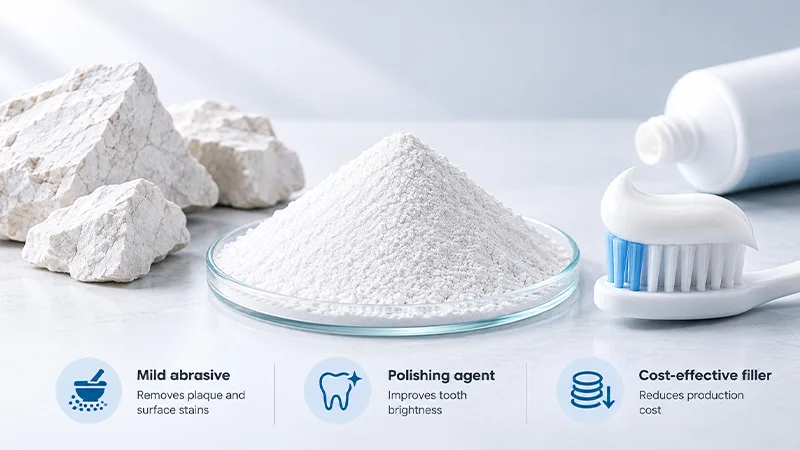
In toothpaste formulations, GCC primarily functions as:
Compared with synthetic abrasives, GCC offers an excellent balance between cleaning performance, safety, and cost. It is one of the most widely used toothpaste ingredients worldwide.
Among various raw materials, high-purity chalk deposits are particularly suitable for producing toothpaste-grade GCC because they are nauturally soft, contain little quartz, and generate powders with low abrasiveness. They are gentle on tooth enamel.
What Are the Quality Requirements of Toothpaste-grade GCC Production?
Different from ordinary calcium carbonate powder, toothpaste-grade GCC should meet strict physical, chemical, and microbiological standards.
For toothpaste manufacturing, the GCC powder should be high-purity. The calcium carbonate content should typically exceed 98%. High purity ensures stable chemical properties, higher product safety, and lower impurity levels. The low-grade ores containing excessive silica, iron, or clay minerals are unsuitable for toothpaste applications.
High whiteness gives toothpaste a clean, bright appearance and reflects the quality of the raw material. Generally, it requires the whiteness value above 94%.
Particle size is one of the most critical specifications. Toothpaste-grade GCC is usually processed into fine powders. According to the different toothpaste formulations, the exact particle size distribution will be different. It is commonly processed to around 600-800 mesh. It mainly depends on the toothpaste formulation and performance requirements. Besides, it should be mentioned that a narrow particle size distribution is essential.
If particles are too coarse:
If particles are too fine:
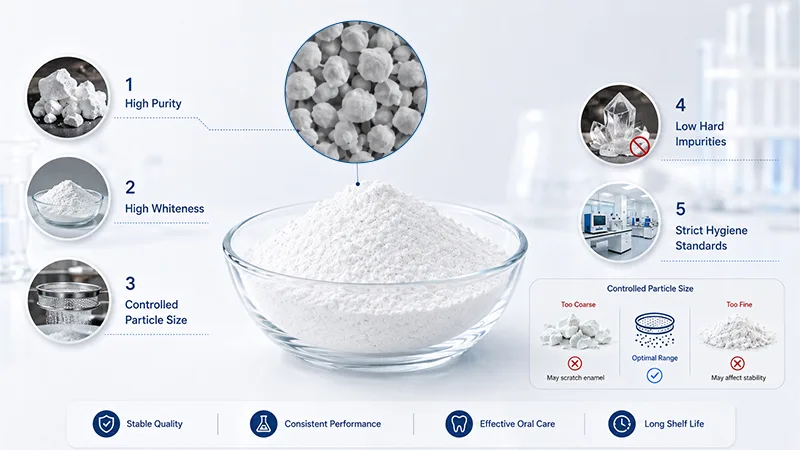
Hydrochloric acid insoluble matter should remain extremely low. It mainly consists of hard minerals such as quartz. These hard particles can significantly increase abrasiveness and also damage tooth enamel. Thus, it is essential to select raw materials carefully and remove impurities.
Toothpaste is an oral care product. Thus, its hygiene requirements are much higher than those of industrial powders. The toothpaste-grade GCC manufacturers must carefully control heavy metals, arsenic, iron content, sulfur compounds, total bacterial count, mold and yeast, and harmful microorganisms.
Except for these, the moisture, volatile matter, water absorption, and PH value must remain within specified limits. This ensures product stability and long shelf life.
Production Process of Toothpaste Grade GCC Powder
Raw Materials Selection
Generally, high-quality chalk, limestone, or marble with high Caco3 content and low content of silica, iron, and other impurities.
For toothpaste manufacturing, soft chalk are more suitable. They produce calcium carbonate powder with low abrasiveness and excellent mouthfeel.
For your calcium carbonate production, upgrading from your ordinary GCC powder to toothpaste-grade products means higher product value and greater market opportunities. However, achieving stable quality requires reliable equipment, which can control particle size, minimize impurities, and maintain continuous production.
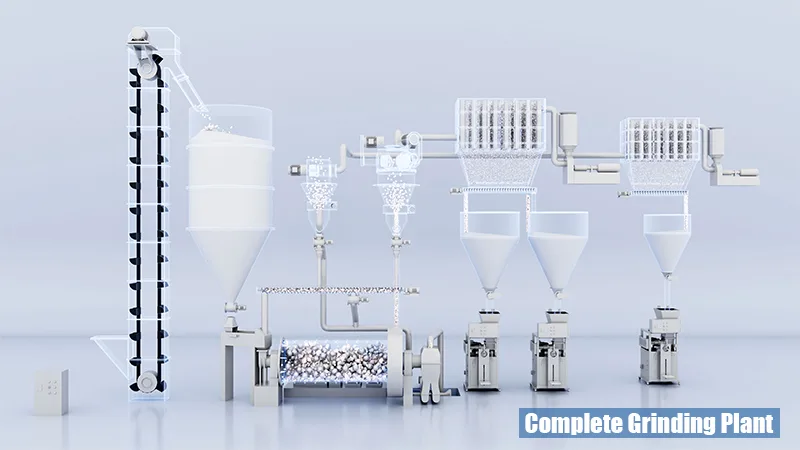
Daswell Powder provides complete calcium carbonate grinding solutions. From ore crushing, fine powder grinding, qualified products separation, dust collector to automatic packing, our ball mill grinding and classifier production line is applicable for you. It is designed to produce high-quality fine GCC powder with stable fineness and consistent performance.
Whether you want to operate a new toothpaste-grade GCC plant or upgrade your existing calcium carbonate production line, we can provide a customized solution based on your raw materials, production capacity, and final product requirements. Contact Daswell Powder and get your advanced grinding solution for increasing the value of your calcium carbonate resources.