

Bead Mill
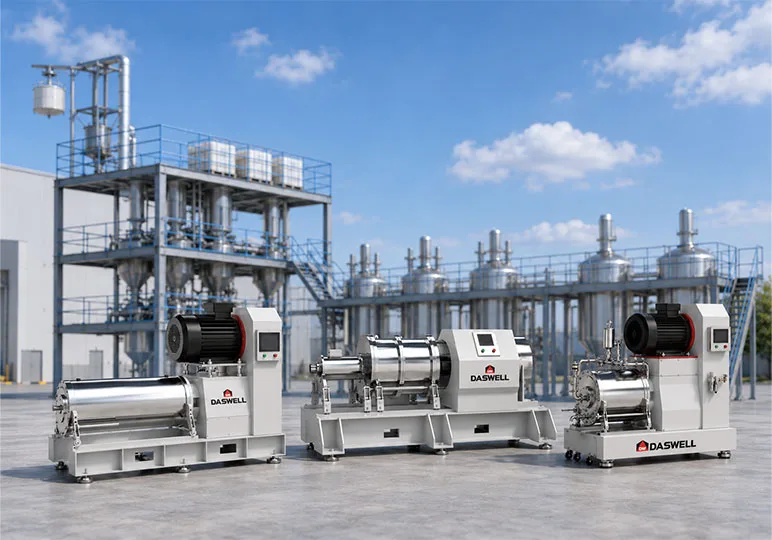
A Bead Mill, also known as a sand mill, is used for wet grinding and dispersion of solid particles in liquid systems. Daswell Powder Bead Mills provides efficient wet grinding and dispersion solutions for agrochermical, mineral slurries, coatings, inks, advanced ceramics, and battery materials.
Available in disc, pin-type, and nano designs, our bead mills offer different configurations for your material and processing requirements from micron-scale grinding to nano-scale dispersion. We can help you select a suitable mill based on slurry characteristics, target particle size, and production needs.
Wet Grinding & Dispersion Solutions
Producing high-quality slurry requires more than simply mixing ingredients. Whether you process ceramic powders, mineral slurries, pigments, battery materials, coatings, inks, or agrochemical formulations, particle size distribution and dispersion quality are important factors in achieving the desired product properties.
Wet Grinding & Dispersion
Daswell Powder offers bead mills for wet grinding and dispersion of solid particles in liquid systems. Grinding media generate impact and shear forces to reduce particle size and break down agglomerates.
Configuration for Your Application
With disc, pin-type, and nano bead mill options, we help you select a suitable configuration for agrochemical and other slurry-processing applications, based on your material and process requirements.
✅ Material characteristics
✅ Production requirements
✅ Target particle size
✅ Temperature control
How Does a Bead Mill Work?
A sand mill is a continuous wet grinding machine that uses grinding media to reduce particle size and disperse solid particles in a liquid.
After premixing, often with a high-speed disperser, the slurry enters a chamber containing grinding media such as zirconium oxide, alumina, zirconium silicate, or silicon carbide beads.
The high-speed rotor agitates the beads, generating impact and shear forces that break down particles and agglomerates. A separation system retains the grinding media while the processed slurry flows out continuously.
Cooling and process control help maintain suitable grinding conditions and consistent product quality.

What Materials Are Suitable for a Bead Mill?
Ceramic Materials

Bead mills are widely used for alumina, zirconia, and other ceramic materials. They are critical in electronic ceramics, structural ceramics, and precision ceramic components.
Battery Materials

For lithium battery production, bead mills provide efficient grinding and dispersion of cathode materials, anode materials, conductive additives, and battery slurry.
Coatings and Ink Materials

Bead mills provide excellent pigment dispersion and particle size control. It improves color development, gloss, storage stability, and coating performance.
Pigment and Fillers

Efficient grinding and dispersion help achieve better color strength, opacity, stability, and product quality. Bead mills are commonly used in pigment manufacturing, color paste production, and specialty filler processing.
Chemical Materials

For chemical processing applications, bead mill machines help achieve finer particle sizes, better dispersion quality, and more consistent product performance. This supports the production of high-value chemical products.
Mineral Slurry

A bead mill machine is also applicable for mineral slurry production. You can use it for refining and dispersing GCC, talc, kaolin, silica, and barite slurries for paper, coatings, plastics, and specialty applications.
Different Types of Bead Mills: Introduction
Daswell offers three types of bead mills for different wet grinding and dispersion requirements: Nano Bead Mills, Pin-type Bead Mills, and Disc Bead Mills. Each design serves specific processing needs, from ultrafine particle size reduction to conventional slurry grinding across a range of industrial applications.
Nano Bead Mill
The Nano Bead Mill is designed for ultrafine wet grinding and nano-scale dispersion of high-value materials. Its high-energy grinding system supports precise particle size control and consistent dispersion, making it suitable for advanced ceramics, lithium battery materials, electronic materials, and functional nanomaterials.

Typical Applications of Nano Bead Mill
◎
Ultrafine Grinding
Precise particle size control
✧
High Dispersion
Uniform material dispersion
◇
Material Compatibility
For high-purity materials
⚙
Consistent Processing
Consistent slurry quality
| Model | Active volume (L) | Grinding main motor power (kW) | Centrifugal separation motor power (kW) | Batch size (L) | Media size (mm) | Weight (Kg) | Dimension L*W*H (mm) |
| DPNB-L-2L | 2L | 7.5 | 5.5 | 5-50 | 0.30-1.0 | 500 | 1200*770*1100 |
| DPNB-L-6L | 6L | 18.5 | 7.5 | 15-100 | 0.03-1.0 | 1200 | 2000*950*1350 |
| DPB-L-10L | 10L | 22 | 11 | 30-200 | 0.03-1.0 | 1400 | 2100*950*1400 |
| DPNB-L-30L | 30L | 45 | 15 | 60-500 | 0.30-1.0 | 1900 | 2300*1250*1650 |
| DPNB-L-60L | 60L | 75 | 18.5 | 150-1000 | 0.03-1.0 | 3600 | 2600*1450*1900 |
| DPNB-L-150L | 150L | 185 | 30 | 300-3000 | 0.30-1.0 | 7500 | 3200*1600*2100 |
Pin-type Bead Mill
The Pin-type Bead Mill uses a high-speed pin rotor to generate intensive impact and shear forces for efficient wet grinding and dispersion. It is suitable for applications requiring fine particle size control and consistent slurry quality, including battery materials, coatings, fine ceramics, graphite, and selected agrochemical formulations.

Typical Applications of Pin-type Bead Mill
◎
Fine Grinding
Controlled particle size reduction
✧
Intensive Dispersion
High-speed impact and shear
◇
Versatile Applications
For a range of slurry materials
⚙
Consistent Processing
Supports consistent slurry quality
| Model | Active volume (L) | Main power (KW) | Batch size (L) | Media size (mm) | Weight (Kg) | Dimension L*W*H (mm) |
| DPB-S-0.3L | 0.3 | 2.2 | 0.3-5 | 0.1-2.0 | 60 | 500*560*540 |
| DPB-S-0.5L | 0.5 | 4 | 2-10 | 0.1-2.0 | 170 | 910*670*750 |
| DPB-S-1L | 1 | 4 | 3-20 | 0.1-2.0 | 190 | 910*670*750 |
| DPB-S-3L | 3 | 11 | 5-100 | 0.1-2.0 | 400 | 1000*900*1550 |
| DPB-S-6L | 6 | 18.5 | 20-200 | 0.1-2.0 | 550 | 1000*900*1550 |
| DPB-S-10L | 10 | 22 | 30-300 | 0.1-2.0 | 1300 | 1000*900*1750 |
| DPB-S-25L | 25 | 37 | 50-1000 | 0.1-2.0 | 1700 | 1650*1050*1550 |
| DPB-S-30L | 30 | 37/45 | 80-1000 | 0.1-2.0 | 1900 | 1650*1050*1550 |
| DPBS-60L | 60 | 75/90 | 200-2000 | 0.1-2.0 | 3600 | 2100*1650*1900 |
| DPB-S-100L | 100 | 110 | 300-4000 | 0.1-2.0 | 5600 | 2400*1650-*2200 |
| DPB-S-150L | 150 | 185 | 800-6000 | 0.1-2.0 | 6800 | 2780*1780*2680 |
| DPB-S-400L | 400 | 355 | 1000-10000 | 0.1-2.0 | 10500 | 4000*1900*2900 |
Disc Bead Mill
The Disc Bead Mill is designed for conventional wet grinding and dispersion, offering a practical solution for stable processing and cost-effective production. Its multiple grinding discs generate turbulence and shear forces to help reduce particle size and improve dispersion across a wide range of slurry applications, including mineral slurries, coatings, inks, pigments, and selected agrochemical formulations.

Typical Applications of Disc Bead Mill
◎
Wet Grinding
Conventional slurry processing
✧
Effective Dispersion
Turbulence and shear
◇
Broad Applications
Minerals, coatings and more
⚙
Practical Production
Cost-effective processing
| Model | Active volume (L) | Main power (KW) | Batch size (L) | Media size (mm) | Weight (Kg) | Dimension L*W*H (mm) |
| DP-S/D-1.4L | 1.2 | 4 | 3-20 | 0.6-2.0 | 150 | 910*670*750 |
| DP-S/D-5L | 5 | 7.5 | 10-200 | 0.6-2.0 | 550 | 1000900*1550 |
| DP-S/D-15L | 15 | 15 | 30-400 | 0.6-2.0 | 800 | 1000*900*1550 |
| DP-S/D-20L | 20 | 22 | 50-500 | 0.6-2.0 | 1100 | 1600*1000*1800 |
| DP-S/D-30L | 30 | 30 | 100-1000 | 0.6-2.0 | 1300 | 1600*1000*1800 |
| DP-S/D-50L | 50 | 45 | 200-1000 | 0.6-2.0 | 1700 | 2000*1150*1650 |
| DP-S/D-60L | 60 | 45 | 200-2000 | 0.6-2.0 | 1800 | 2150*1150*1650 |
| DP-S/D-100L | 100 | 75 | 300-3000 | 0.6-2.0 | 2500 | 2600*1450*1950 |
| DP-S/D-150L | 150 | 90 | 500-5000 | 0.6-2.0 | 3100 | 2700*1450*1950 |
| DP-S/D-300L | 400 | 110 | 1000-10000 | 0.6-2.0 | 4500 | 2970*1550*2200 |
| KP-S/D-500L | 500 | 165 | 1500-12000 | 0.6-2.0 | 6500 | 3200*1650*2400 |
| KP-S/D-1000L | 1000 | 400 | 2000-15000 | 0.6-2.0 | 9500 | 3800*1850*3050 |
AGROCHEMICAL APPLICATIONS
How Does Bead Milling Support Agrochemical Formulations?
Bead milling can support liquid agrochemical formulations that contain solid particles requiring wet grinding. It reduces particle size and breaks down agglomerates within a prepared slurry; suitability depends on the formulation and the selected mill configuration.
Suspension Concentrates (SC)
For solid active ingredients suspended in a liquid, wet bead milling helps control particle size and dispersion. Formulation additives and process conditions also influence suspension stability.
Flowable Concentrates for Seed Treatment (FS)
The solid-particle suspension stage of suitable FS formulations may use bead milling before final formulation adjustment. Seed-treatment additives and the order of addition should be assessed for the specific formulation.
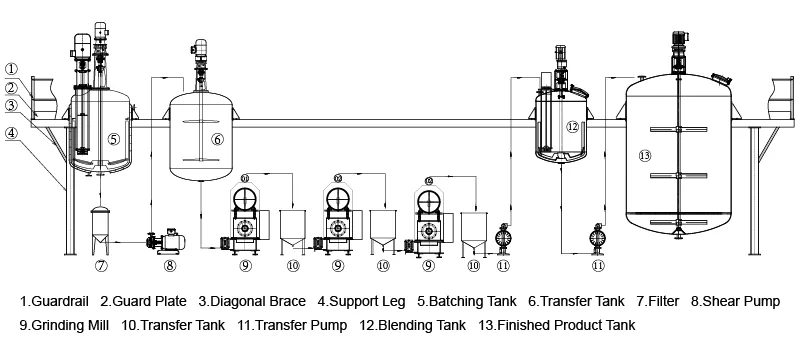
Illustrative process flow
Premixing & dispersion
Wet bead milling
Particle-size check
Final blending & quality control
What Should You Consider When Grinding Agrochemicals?
Review these factors for your formulation and process requirements.
Particle-size target
Define the required distribution and confirm it through grinding trials.
Slurry properties
Check solids content, viscosity, and pumpability.
Temperature control
Match cooling and operating conditions to the formulation’s heat sensitivity.
Materials & cleaning
Assess compatibility of wetted parts and grinding media, wear contamination, and cleaning between products.
FAQ
How do I choose a bead mill for my material and production needs?
Start with the material or slurry characteristics, target particle size, and required batch size or throughput. These requirements help guide the choice of mill type and configuration. Grinding media, contact materials, cooling, and cleaning requirements should also be reviewed. Final selection should be confirmed for the specific material and process conditions.
What information should I provide before selecting a bead mill?
Please share your material or application, whether the slurry is water-based or solvent-based, and any available information on solids content, viscosity, and feed particle size. Include your target particle size, production requirements with units, and any temperature or cleaning limits. If some details are not yet available, send what you know so we can discuss the next steps.
How is suitability assessed for an agrochemical formulation?
Assessment starts with the formulation type and whether it requires wet grinding of solid particles in a liquid carrier. Relevant factors include material properties, target particle size distribution, viscosity, temperature limits, and compatibility with product-contact materials.
Cleaning and changeover requirements should also be considered. Suitability and achievable results need to be confirmed for the specific formulation; trial results may be needed before final equipment selection.
Except for the sand mill machines, we also provide customized bead mill production solutions, including sand mills, mixing systems, storage tanks, filtration systems, and automatic controls.
Share your formulation type, slurry properties, target particle size, and required throughput with Daswell Powder to discuss a suitable configuration. Final suitability should be confirmed by material testing. Our engineers will help you select the most suitable configuration for your project!