
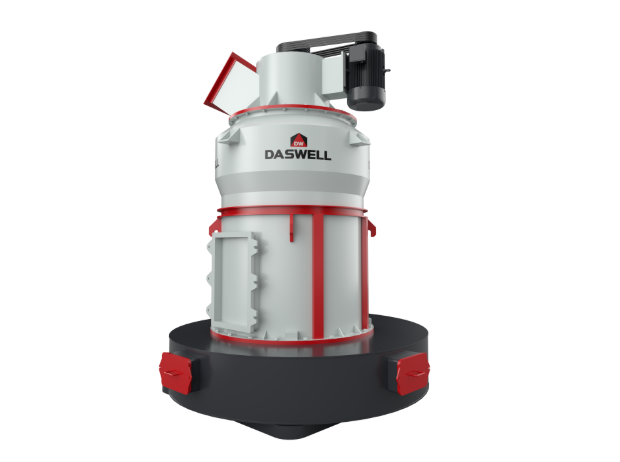
Raymond Mill
Raymond mill is also known as the Raymond roller mill. It is a high-efficiency grinding machine with a classification function. It is mainly designed for stable and precise powder production.
With consistent particle size control and reliable performance, Raymond mills are widely used in producing powders for industrial applications.
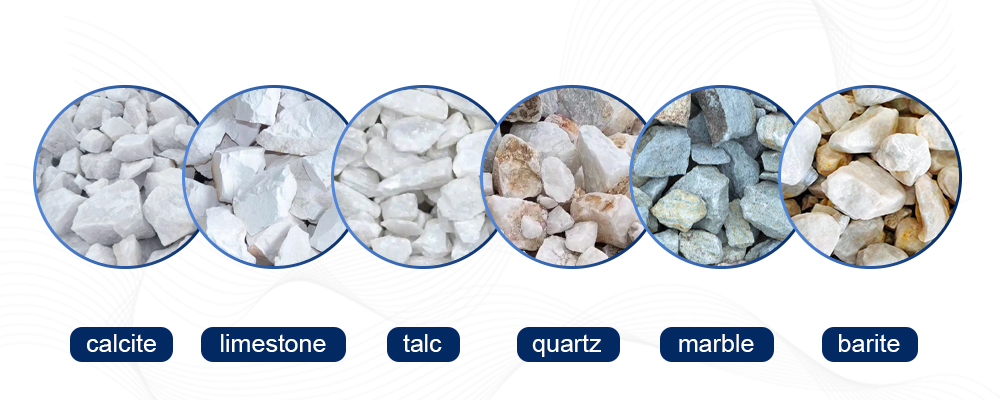
The Raymond Grinding Mill is designed for consistent fineness and stable performance in a powder production plant. Producing high-quality mineral powders at scale, this machine performs well with low power consumption. It easily handles a wide range of materials—calcite, limestone, talc, quartz, gypsum, feldspar, marble, bentonite, dolomite, barite, graphite, and more—with Mohs hardness below 7 and humidity under 6%.
Whether you’re in mining, chemicals, building materials, or filler production, the Raymond mill delivers reliable output, low energy consumption, and precise particle control.
Contact DaswellPowder for upgrading your production line with a Raymond mill machine now.
Working Principle
How does the Raymond mill turn material into powder efficiently?
Uniform feeding: After crushing the large materials into the required feed size, the bucket elevator conveys them to the storage bin. The vibrating feeder delivers the small-sized material evenly into the grinding chamber of the Raymond mill machine.
Air transporting: The blower sends air from the dividing plate into the grinding chamber. This carries the crushed powder upward to the classification chamber for separation.
Precise classification: Similar to the ring roller mills, the Daswell Powder Raymond mill also has a built-in classifier. The adjustable-speed motor drives the classifier impeller to classify particles. The qualified fine powder will pass with the airflow into the dust collector as the finished product. And the oversized particles will fall back into the grinding chamber for regrinding.
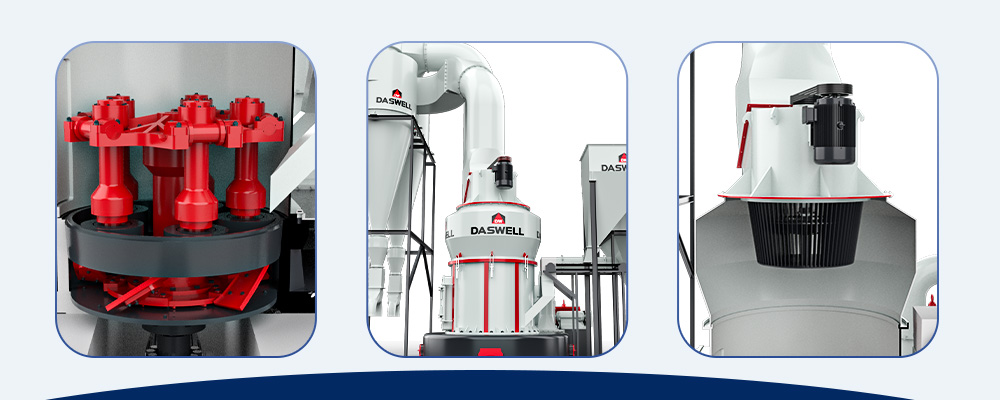
Key parts of the Raymond mill machine
Shovel and grinding roller inside the Raymond mill: The shovel is located below the grinding roller. It lifts material into the grinding zone between the roller grinding ring. The rotation of the roller exerts extrusion pressure, crushing the material into fine powder uniformly.
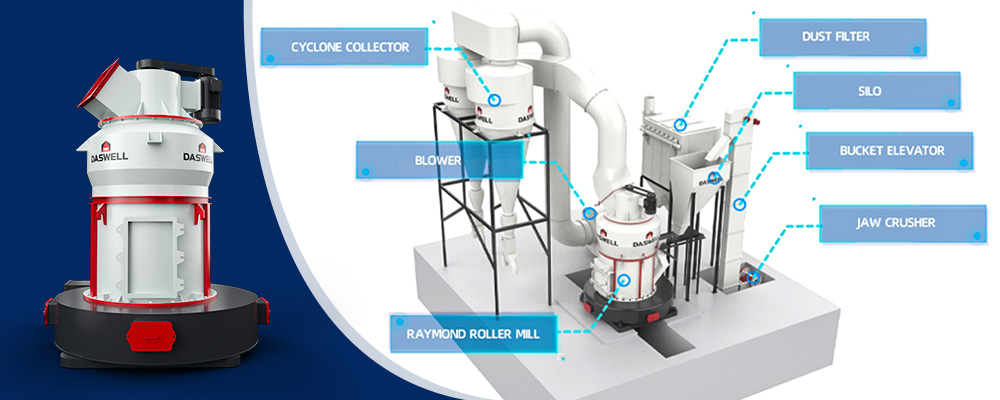
Main parts: The Raymond mill system includes the main machine(frame, shovel, grinding roller, grinding ring, housing, motor), separator, and the blower.
Auxiliary equipment configurations for Raymond mill powder processing plant: Auxiliary equipment may include a jaw crusher, a bucket elevator, a vibrating feeder, a dust collector, an automatic packing machine, and an electric control cabinet.
For your different materials, such as calcium carbonate processing, talc grinding, barite powder grinding, or some other materials, we can customize for you.
Features and Advantages
High-quality and uniform powder production
The sieving rate of the Daswell Powder Raymond mill machine is up to 99%, ensuring consistent fineness. It is better than other grinding mills like ball mills and ring roller mills.
Advanced classification and high output
The built-in classifier and high-pressure fan provide precise particle separation, strong pneumatic conveying, and high processing capacity.
Compact Vertical Design
It is convenient for you to install. It has a smaller size than the ball mill and the ring roller mill. From feeding to grinding and packaging, the whole Raymond grinding mill powder production system occupies minimal space.
Durable components and efficient grinding
It has a long service life, stable operation, and maximum grinding efficiency. We utilize alloy-steel shovels, wear-resistant rollers, and grinding rings for manufacturing machines.
Efficient and Automatic operation
DaswellPowder Raymond mill machine ensures safer, easier, and more efficient production management. The whole powder processing line is equipped with a centralized electrical control system, allowing unmanned operation.
Technical Data
| Model | 3R1000 | 3R1224 | 4R1630 | 4R1730 | 4R1830 |
| Roller quantity(piece) | 3 | 3 | 4 | 4 | 4 |
| Max. feeding size(mm) | 20 | 20 | 30 | 30 | 35 |
| Product size(µm) | 25-198 | 25-198 | 38-198 | 38-198 | 45-198 |
| Capacity(t/h)(based on different raw material fineness) | 1-7 | 2-14 | 2.5-24 | 3-25 | 6-30 |
| Roller ring outer diameter(mm) | Φ970 | Φ1280 | Φ1620 | Φ1700 | Φ1850 |
| Total power(kw) | 97 | 145 | 264 | 322 | 417 |