
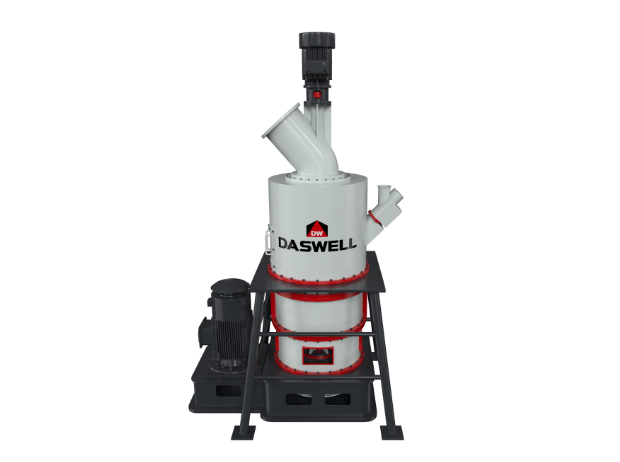
Ring Roller Mill
The DaswellPowder Ring Roller Mill is a high-efficiency micro powder grinding solution designed for producing fine and stable mineral powders. It is suitable for minerals with a Mohs hardness ≤5, a moisture content ≤5%, and a feed size ≤10 mm.
With multi-layer grinding rollers, strong crushing force, and a built-in classifier, it delivers consistent fineness and outstanding productivity.
The ring roller grinding mills is the core grinding unit in the mineral powder grinding line. It directly determines the final powder fineness, particle size distribution, and overall production efficiency.
In a complete grinding plant, this machine works together with crushing systems to form a continuous and stable powder processing workflow.
From pre-crushed limestone or marble to micron-level calcium carbonate powder, the ring roller grinding mill machine plays a decisive role in transforming raw materials into high-value industrial products.
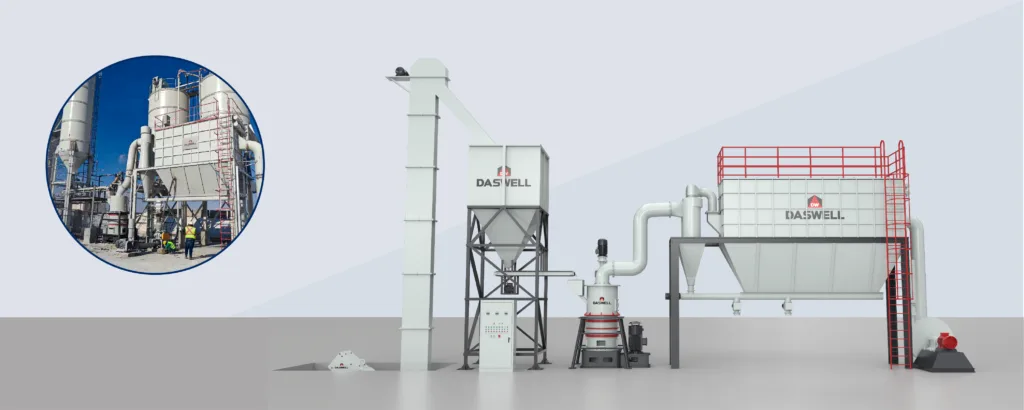
Role of Ring Roller Grinding Mill in the Mineral Powder Grinding Plant
In a typical calcium carbonate powder production line, the process includes:
Crushing → Grinding → Classification → Dust Collection → Packing
Among these processing stages, the ring roller grinding mill machine is responsible for:
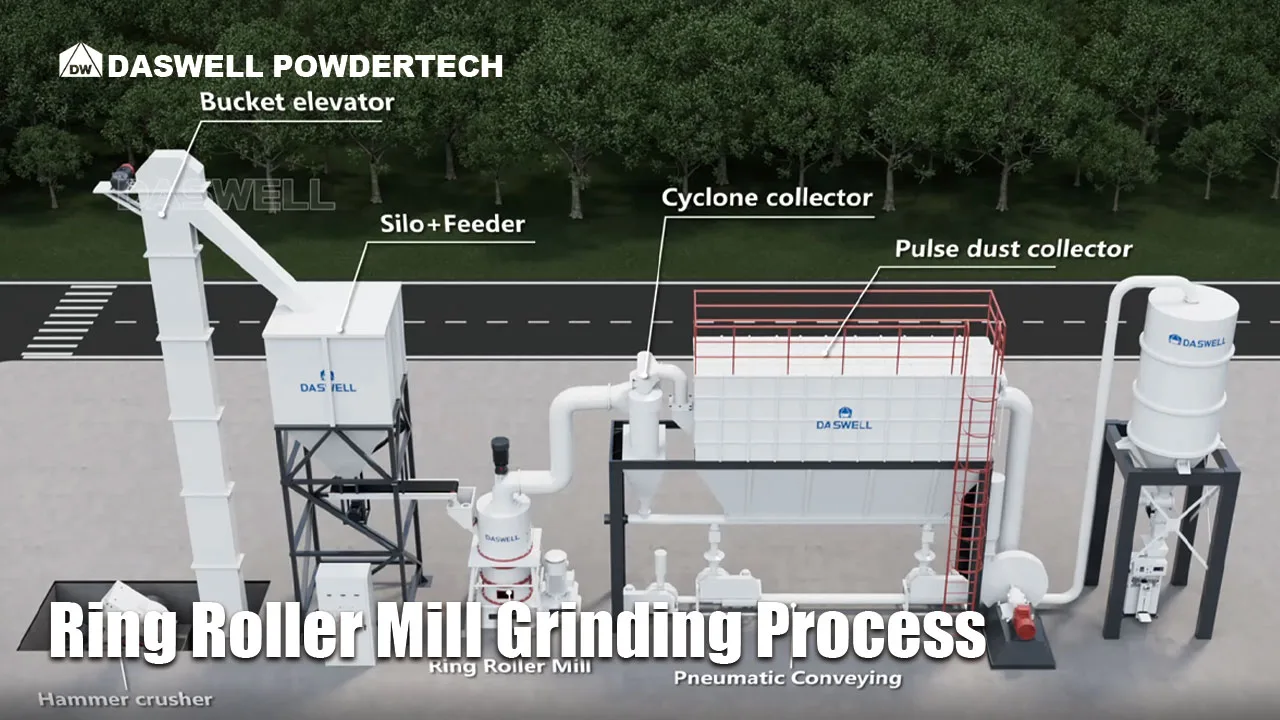
Compared with other equipment, the grinding stage is the most critical. It directly affects the powder product quality and downstream applications.
The ring roller mill achieves efficient grinding through roller pressure and ring interaction, enabling stable and controlled fine powder production.
Advantages of Using Ring Roller Grinding Mill in Mineral Powder Processing Plant
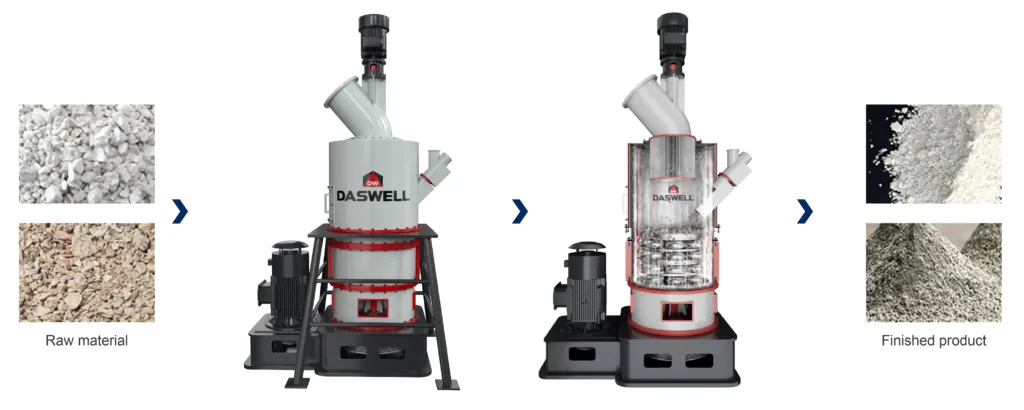
Working Principle of the Ring Roller Mill
This machine combines centrifugal force, rolling pressure, and airflow classification for grinding. It enables efficient and continuous fine powder production.
This closed-loop system ensures precise fineness control and stable product quality.
Uniform feeding into the mill
After crushing, the raw materials are delivered into the mill through a belt feeder. This ensures stable and uniform feeding for consistent grinding performance.
Centrifugal distribution of materials
Once inside the mill, the turntable rotates at high speed. This generates centrifugal force that disperses the materials evenly toward the grinding zone along the ring.
High-pressure rolling and grinding
The grinding rollers rotate on their own axis while revolving around the grinding ring. Under strong pressure, the materials are continuously crushed, compacted and ground into finer particles.
Multi-layer grinding process
The mill is designed with multiple grinding layers, typically three to four. When the materials pass through each layer, they undergo repeated rolling, shearing, and grinding. This significantly improves efficiency and ensuring uniform particle size.
Integrated airflow classification
Ground particles are carried upward by airflow to the built-in classifier. The classifier separates particle based on size:
Coarse materials fall back into the grinding zone for further grinding
Fine materials proceed to the next stage, ensuring accurate fineness.
Applications of the ring roller mill
The ring roller mill machine is widely used in fine and ultrafine powder production lines for soft to medium-hard non-metallic minerals. This grinding system is especially suitable for industrial powder plants, which process materials with Mohs hardness up to 5. It ensures efficient grinding without excessive wear.
Typical raw materials and Mohs hardness:
- Calcium carbonate (Mohs hardness ~3)
- Limestone (Mohs hardness ~3)
- Dolomite (Mohs hardness 3.5–4)
- Barite (Mohs hardness 3–3.5)
- Talc (Mohs hardness ~1)
- Kaolin (Mohs hardness 2–2.5)
- Gypsum (Mohs hardness ~2)
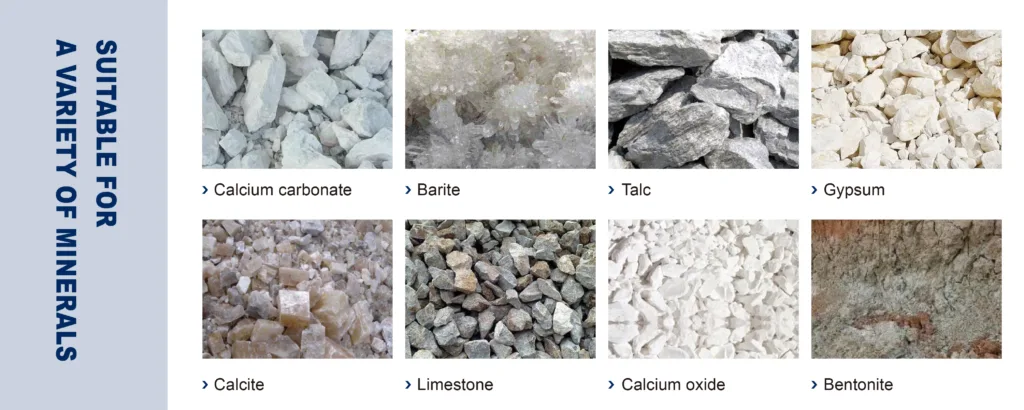
Materials within this hardness range can be processed efficiently. Meanwhile, it maintains stable wear rates and long service life of grinding components.
The typical fineness produced by a ring roller mill is D97 5-45 μm. The particle size can be controlled through roller pressure adjustment, airflow regulation, and integrated air classification. This ensures consistent powder quality for downstream applications.
Contact Daswell Powder, and get your micro powder ring roller mill solution!
Technical Data
| Model | DR-21 | DR-28 | DR-34 | |
| Roller number (pcs) | 21 | 28 | 34 | |
| Feed size (mm) | ≤10 | ≤10 | ≤10 | |
| Feed material moisture (%) | ≤3% | ≤3% | ≤3% | |
| Fineness (μm) | 3.5-45μm | 5-50μm | 5-50μm | |
| Output (kg) | 500-4000 | 800-7000 | 1700-12000 | |
| Installed power (kw) | Main motor | 75 | 132 | 185-200 |
| Classifier | 18.5-22 | 30 | 55-75 | |
| Blower | 45-55 | 55-75 | 132 | |
| Feeder | 1.5-3 | 1.5-3 | 3 | |
| Discharge screw | 3 | 3 | 3-6 | |
| Compressed air used (m3) | 1.53-23 | 23 | 23 | |